

A news summary is a concise, structured presentation of the main facts, context, and significance of a news story, designed to help you grasp essential information in under five minutes. The term "news summary" is used broadly, but the recognized editorial term is news brief or digest, and both refer to the same core practice: filtering the day's events into what actually matters. Platforms like Thexreporter and editorial standards from outlets such as The Associated Press treat summaries as a distinct format, not a shortened article. The five-sentence summary method, popularized in academic and newsroom settings, gives this format a repeatable structure that works across politics, markets, and breaking news.
What is a news summary and why does it matter?
A news summary is defined as a specialized filtering tool designed to answer four core questions: What happened, why it matters, what is unconfirmed, and what to watch next. That definition separates a true summary from a simple headline or a rewritten article. A headline tells you what occurred. A summary tells you what it means and what comes next.
The news summary definition also carries a structural implication. Effective summaries typically feature 2 primary developments and 3–5 secondary items across major beats, organized into categories such as government, business, public safety, international developments, and culture. That structure respects your time and builds a reliable reading habit.

The importance of news summaries becomes clear when you consider the alternative. Without a structured digest, you face a flood of headlines, opinion pieces, and duplicate reports with no clear signal about what actually changed today.
What are the essential elements of an effective news summary?
The structure of a strong news summary follows a clear, repeatable pattern. The five-sentence summary approach starts with the main topic and context, continues with key supporting facts or developments, and ends with an overall conclusion or implication. This method works for hard news, opinion pieces, and financial reports alike.
Here is how each component functions:
- First sentence: Identifies the main topic, the key actor, and the core event. No background, no history.
- Middle sentences (2–4): Present the most significant supporting facts, data points, or direct consequences. Each sentence carries one idea.
- Final sentence: States the conclusion, implication, or what readers should monitor going forward.
| Element | Purpose |
|---|---|
| Opening identification | Anchors the reader to the story immediately |
| Supporting facts | Provides evidence and context without padding |
| Conclusion or implication | Signals why the story matters beyond the event itself |
| "What to watch" note | Keeps the reader engaged with developing stories |
A well-built summary also flags uncertain claims and includes verification notes when relevant. That transparency is what separates a trustworthy digest from a rushed rewrite.
Pro Tip: Keep your summary to 150–250 words for daily news digests. Anything longer risks becoming an article. Anything shorter risks losing necessary context.
How do news summaries manage information overload?
Effective news summaries act as signal filters rather than mere condensations, prioritizing actionable intelligence and categorizing information to manage overload. That distinction matters. A condensation just makes an article shorter. A signal filter decides what belongs in your attention at all.
The signal filter approach organizes information into three practical categories:
- What changed: New facts, confirmed developments, or official statements that alter the previous understanding of a story.
- Who is affected: The specific groups, institutions, or markets that face direct consequences from the development.
- What to monitor: Unresolved questions, scheduled announcements, or secondary effects that will determine how the story develops.
This framework also identifies hype and duplicate reports, saving you from reading the same story repackaged across ten outlets. Comparing 5–10 publications helps identify where sources agree and where they diverge, which is the clearest signal of genuine news versus amplified noise.
"Synthesis across multiple sources differentiates useful news summaries from noisy ones that merely rewrite headlines." — AI Summary Tools for News
Pro Tip: When consuming news digests, check whether the summary cites multiple sources or just one. Single-source summaries carry a higher risk of missing context or reflecting one outlet's editorial bias.
For a practical framework on reading breaking developments, Thexreporter's guide on understanding breaking news walks through the exact process.
What are the steps to create a high-quality news summary?
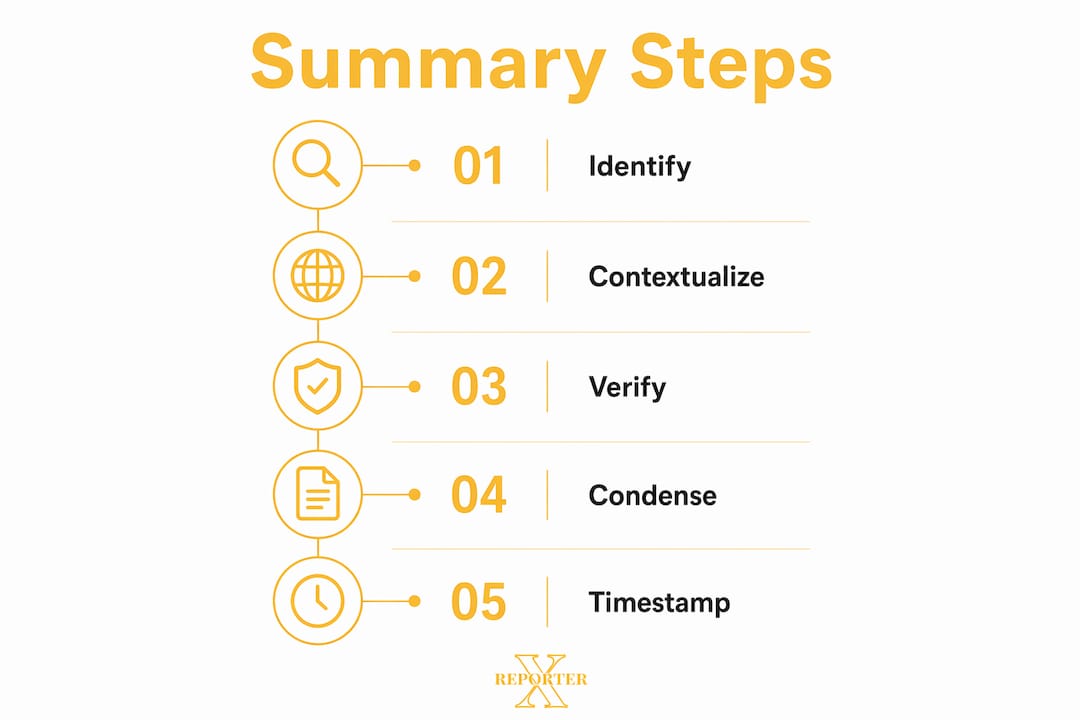
Creating a reliable news summary requires more than reading an article and cutting it down. The process follows a defined sequence that protects accuracy and maintains reader trust.
- Set explicit goals: Define the target length (150–250 words for daily digests), the intended audience, and the subject scope before writing a single sentence.
- Choose your summarization method: Extractive summarization pulls direct quotes and key sentences from source material. Abstractive summarization rewrites the core ideas in new language. Abstractive produces more readable summaries but requires stronger editorial judgment.
- Verify source credibility: Check the publication's track record, the article's metadata (date, author, update history), and whether the claim appears in at least two independent sources.
- Apply the S.A.M.P.L.E. checklist: The S.A.M.P.L.E. framework covers Source, Accuracy, Multiple perspectives, Preserving context, Length, and Evidence. Each element guards against the most common failure points in AI-generated and human-written summaries.
- Maintain continuous updates: A well-maintained summary adapts as stories move from breaking to developing to settled stages. Outdated summaries are a direct misinformation risk.
The S.A.M.P.L.E. checklist is particularly critical when using AI tools to draft summaries. Common pitfalls include hallucinations, omission of nuance, and missing metadata that changes the meaning of a claim entirely.
Pro Tip: Always timestamp your summary and note the last update. Readers need to know whether they are reading a five-minute-old brief or a five-day-old one.
For a full production checklist aligned with 2026 editorial standards, see Thexreporter's daily news briefing checklist.
How do news summaries improve your news consumption?
News summaries serve as orientation tools that function as narrative navigation pages, helping you decide which stories deserve deeper investigation. They do not replace investigative journalism. They make investigative journalism more accessible by telling you where to look first.
The benefits are concrete:
- Faster orientation: You identify the two or three stories that directly affect your sector, region, or interests within minutes.
- Reduced cognitive load: A structured digest prevents decision fatigue from scanning dozens of unrelated headlines.
- Misinformation defense: Summaries that apply multi-source synthesis reduce the risk of amplifying unverified claims.
- Genre clarity: A good summary distinguishes hard news from opinion, analysis, and sponsored content, which most raw feeds do not.
| Benefit | Practical Impact |
|---|---|
| Faster orientation | Identify key stories in under five minutes |
| Misinformation defense | Multi-source synthesis flags unverified claims |
| Genre clarity | Separates hard news from opinion and analysis |
| Deeper follow-up support | Directs readers to full articles when needed |
For readers who need to catch up on missed news quickly, a well-structured digest is the most time-efficient starting point available.
Key takeaways
A news summary is most effective when it answers four questions, follows a defined structure, and draws from multiple verified sources rather than condensing a single article.
| Point | Details |
|---|---|
| Core definition | A news summary answers what happened, why it matters, what is unconfirmed, and what to watch next. |
| Five-sentence structure | Open with the main topic, support with key facts, and close with the implication or next development. |
| Signal filter function | Categorize information into what changed, who is affected, and what to monitor to cut through noise. |
| S.A.M.P.L.E. verification | Apply Source, Accuracy, Multiple perspectives, Context, Length, and Evidence checks before publishing. |
| Continuous maintenance | Update summaries as stories evolve from breaking to settled to prevent misinformation. |
News summaries in 2026: what experience actually teaches
The conventional advice on news summaries focuses almost entirely on brevity. Keep it short. Cut the fluff. That advice is incomplete. Brevity without synthesis produces noise at a smaller scale.
What I have found working with editorial formats over time is that the most trusted summaries are not the shortest ones. They are the ones that make a clear editorial judgment about what changed and why it matters, then signal what remains unresolved. That last part, the "what to watch" element, is what most summaries omit. Readers do not just want a snapshot. They want a map.
The rise of AI-generated summaries in 2026 has made this problem more visible. AI tools produce fast, clean condensations. They struggle with editorial judgment. A tool that summarizes a single article will miss the divergence between how Reuters and The Wall Street Journal frame the same Federal Reserve decision. That divergence is often the actual story.
Media literacy now requires understanding not just what a summary says, but how it was built. Single-source, AI-generated digests carry real risks. Multi-source synthesis, applied with the S.A.M.P.L.E. checklist, is the standard worth holding. The readers who develop that habit will consistently outperform those who rely on whatever summary arrives first in their feed.
— Trevor
Stay informed with thexreporter's live news summaries
Thexreporter delivers exactly the kind of multi-source, structured news summaries this article describes.
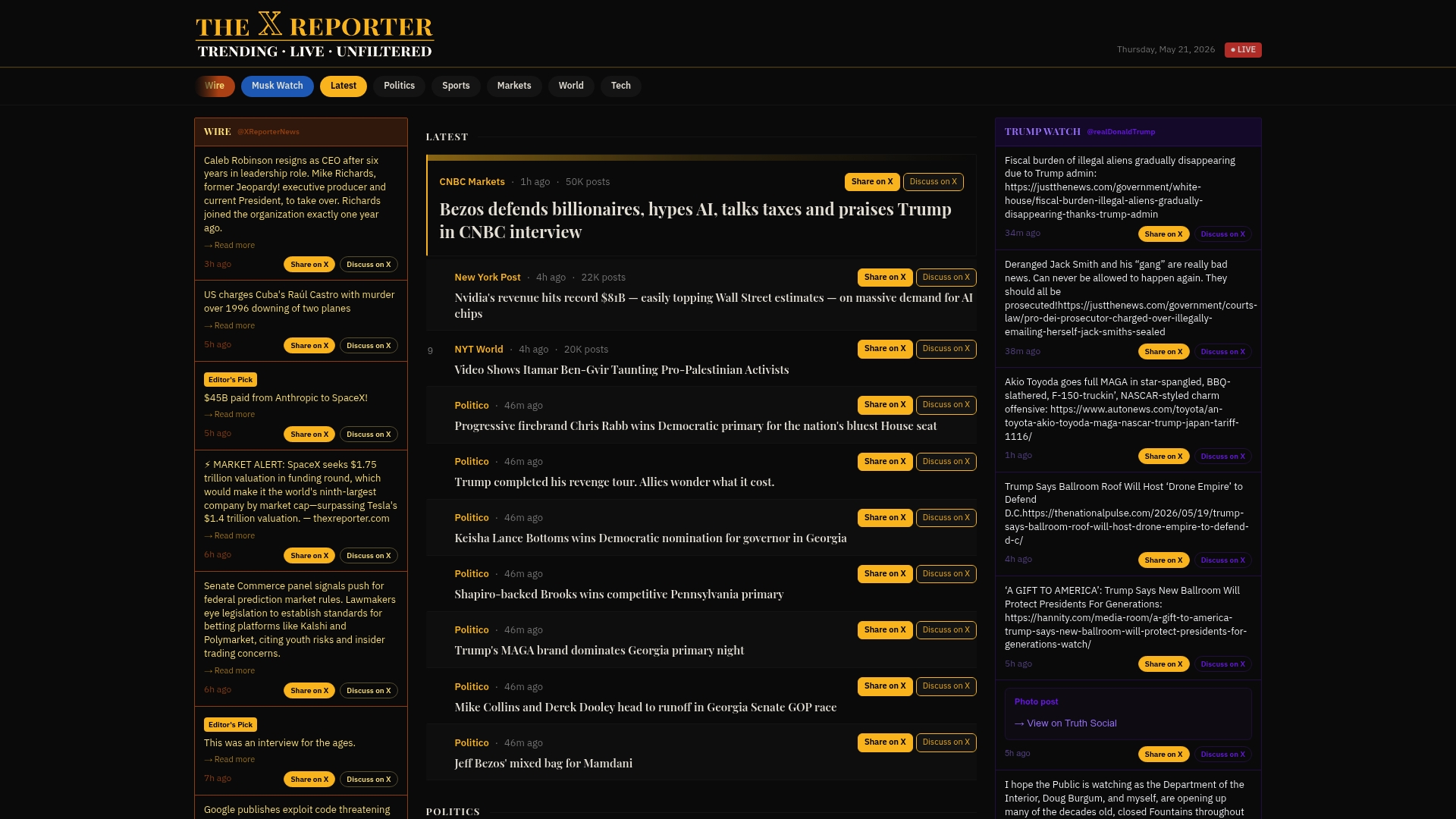
The platform covers politics, tech, and markets with concise editorial digests built to answer the four core questions: what happened, why it matters, what is unconfirmed, and what to watch next. Every summary reflects synthesis across sources, not a single-outlet rewrite. For readers who want to stay current without spending an hour scanning feeds, Thexreporter provides the signal without the noise. Visit Thexreporter to access live, trending, and unfiltered news summaries updated throughout the day. You can also explore how news consumption decisions are being optimized for professionals in 2026.
FAQ
What is the news summary definition in journalism?
A news summary is a concise, structured digest that presents the main facts, context, and significance of a news story. In journalism, it answers four questions: what happened, why it matters, what is unconfirmed, and what to watch next.
How long should a news summary be?
A standard news summary runs 150–250 words for daily digests. Longer formats covering multiple beats may reach 400–500 words while still maintaining the structured, scannable format.
What is the five-sentence summary method?
The five-sentence method starts with the main topic, adds 3 sentences of supporting facts or developments, and closes with a conclusion or implication. It works for news articles, opinion pieces, and financial reports.
Why are multi-source summaries more reliable?
Multi-source synthesis involving 5–10 publications identifies where sources agree and where they diverge, which reduces the risk of amplifying unverified claims or missing critical context that a single outlet may omit.
What is the s.a.m.p.l.e. checklist for news summaries?
The S.A.M.P.L.E. checklist covers Source, Accuracy, Multiple perspectives, Preserving context, Length, and Evidence. It is the standard quality assurance framework for verifying AI-generated and human-written news summaries before publication.