

Preparing an effective daily news briefing checklist is one of the most demanding tasks in a modern newsroom. The volume of incoming information grows daily, and the pressure to deliver accurate, relevant summaries within tight deadlines leaves little room for improvised workflows. Without a structured system, briefing prep easily becomes reactive, inconsistent, and prone to verification gaps. This article presents a practical, tested checklist built specifically for news professionals who need to move fast without sacrificing editorial standards. Every item in this checklist reflects current best practices and real newsroom workflows.
Table of Contents
- Key takeaways
- 1. The daily news briefing checklist: core standards to set first
- 2. Scan prioritized sources with a timed window
- 3. Sort every story into four clear buckets
- 4. Run the verification chain before any item advances
- 5. Craft concise, precise summaries for each selected story
- 6. Add at least one local or audience-specific angle
- 7. Apply a gate checklist before publishing
- 8. Label uncertainty explicitly in your CMS
- 9. Compare your timing framework: 15 vs. 20 minutes
- My take on what makes this checklist actually work
- Stay ahead of the news cycle with Thexreporter
- FAQ
Key takeaways
| Point | Details |
|---|---|
| Time-box your routine | A 15 to 20 minute timed prep window prevents drift and forces decisive editorial choices. |
| Use a four-bucket sort | Classify every story as publish, monitor, archive, or ignore to sharpen briefing focus. |
| Verify before you publish | Trace every claim to a primary source and document your verification steps with URLs and dates. |
| Always include a local angle | At least one audience-specific or local story significantly raises engagement with your briefing. |
| Disclose uncertainty clearly | Label unverified items in your CMS and require human approval before any uncertain content goes live. |
1. The daily news briefing checklist: core standards to set first
Before you open a single news source, define what your briefing must accomplish. A checklist without clear criteria is just a task list. These standards function as filters for every editorial decision that follows.
Conciseness and time-boxing. A briefing that runs too long or takes too long to prepare defeats its own purpose. Hard timers during prep prevent what is known as Parkinson's Law in the newsroom: work expands to fill available time. Commit to a fixed window before you start.
Verification and credibility. Every item in your briefing must be sourced. If it cannot be traced to a primary or credibly corroborated source, it does not belong in a published briefing.
Audience relevance. A daily news summary written for a financial audience looks entirely different from one built for a general news reader. Define your audience before you define your story set.
Balanced coverage. Include national, sectoral, and at least one local or audience-specific story. A briefing that only covers wire headlines misses the context that makes it genuinely useful.
Source transparency. Note your sources and be prepared to share that documentation internally. Leading outlets publish detailed verification policies and maintain corrections archives openly.
Pro Tip: Create a one-page "briefing criteria card" pinned to your workspace. Before selecting any story, check it against your stated standards. This single habit eliminates the most common source of editorial drift.
2. Scan prioritized sources with a timed window
The first active step in any news briefing guide is structured scanning. Not all sources carry equal weight, and not all information warrants your limited prep time.
Organize your sources into tiers. Primary sources sit at the top: official government websites, regulatory notices, central bank statements, and direct company announcements. Below that come trusted editorial summaries from established outlets. Community chatter and social platforms sit at the bottom tier.
Effective briefing workflows use a 20-minute timed scan with prioritized source tiers, selecting only 3 to 5 focus items. Work through your source tiers from top to bottom during that window. Stop when the timer ends.

Resist the pull of volume. More stories do not produce a better briefing. They produce a longer one that readers will not finish.
3. Sort every story into four clear buckets
Once you complete your scan, classification comes next. Every story you encountered during the scan falls into one of four categories.
- Publish now. The story has a clear angle, passes verification, and directly serves your audience.
- Monitor. The story is developing. Verification is incomplete or the impact is not yet clear. Keep it visible but do not commit to it yet.
- Archive. The story has potential for a future briefing or an explainer but is not time-sensitive today.
- Ignore. The story fails audience relevance, credibility, or significance tests.
This four-bucket classification sharpens every editorial decision by forcing you to commit. The "monitor" bucket is particularly valuable during breaking news cycles where facts are still emerging.
4. Run the verification chain before any item advances
Verification is not a single step. It is a structured chain that every "publish now" item must complete before it enters your briefing.
Editorial verification requires tracing claims to primary sources, independent corroboration, numerical checks, and documentation. The process includes confirming the identity of cited sources, verifying quoted statements against originals, checking numerical claims for accuracy, and logging each source with its URL and access date.
Do not abbreviate this chain under deadline pressure. A single unverified claim in a briefing can undermine the credibility of every accurate item surrounding it.
Pro Tip: Build a shared verification log in a simple spreadsheet or your CMS. Each story entry should include the primary source URL, date accessed, and the name of the person who verified it. This creates an audit trail with near-zero additional effort.
5. Craft concise, precise summaries for each selected story
A verified story still needs to be communicated clearly. The summary step is where editorial voice and judgment meet factual accuracy.
Each summary in your briefing should answer three questions: what happened, why it matters to your audience, and what comes next. Keep summaries to three to five sentences. Anything longer belongs in a separate explainer or follow-up piece.
Producing a ladder of content formats, from brief updates to deep explainers to newsletters, maximizes both comprehension and repeat visits. The briefing itself is the first rung. Write it accordingly.
Avoid numerical vagueness. "The index fell sharply" is less useful than "The index fell 1.4 percent." Precision signals authority.
6. Add at least one local or audience-specific angle
Every morning news roundup should contain at least one story that speaks directly to where your audience lives or works. This is not optional context. It is a documented engagement driver.
Local news coverage represents the highest engagement segment for radio and digital briefing audiences. It is also the clearest differentiator between a generic wire summary and a briefing people return to.
For a financial news briefing, this might mean one regional market story or a development that affects a specific sector your readers operate in. For a general news briefing, it means one story from your audience's city, state, or industry.
7. Apply a gate checklist before publishing
The gate checklist is a final quality check that runs immediately before any content enters publication. Think of it as the last filter in your editorial pipeline.
A practical gate checklist covers the following: Has the primary source been confirmed? Is the claim still current as of today? Does this story serve the stated audience? Does the summary avoid overclaiming or speculative language? Is the source attribution visible within the content?
This editorial gate system separates the intake decision from the publication decision. That separation is what prevents speed from overriding accuracy.
8. Label uncertainty explicitly in your CMS
Not every story will reach full verification before your briefing deadline. The professional response is not to publish a guess. It is to label the item's status accurately.
Labeling items as unverified, draft, or context-only in your CMS, with a requirement for human approval before publication, is now a recognized standard for responsible real-time journalism. Explicitly marking uncertain stories prevents accidental misinformation amplification, particularly during fast-moving breaking news cycles.
This practice also protects your briefing's credibility over time. Audiences trust publications that acknowledge what they do not yet know.
9. Compare your timing framework: 15 vs. 20 minutes
Not every newsroom runs on the same clock. Two widely used briefing prep routines reflect different editorial priorities.
| Framework | Duration | Story count | Focus |
|---|---|---|---|
| 15-minute radio prep | 15 min | 3 stories | Headlines, angles, local check, teases |
| 20-minute source-tiered scan | 20 min | 3 to 5 items | Source tiers, gate checklist, documentation |
The 15-minute radio checklist prioritizes speed and audience-facing clarity. The 20-minute tiered scan adds source documentation and a more formal gate review. Neither is universally superior. The right choice depends on your publication format, team size, and verification requirements.
Both frameworks share one non-negotiable: a hard timer. Without it, briefing prep expands until it consumes the time you needed for actual reporting.
My take on what makes this checklist actually work
I have reviewed enough daily news briefings to identify what separates the credible ones from the cluttered ones. The difference is almost never talent. It is almost always discipline.
The briefings I consider most reliable share three habits: a hard story limit, a documented verification trail, and a local angle that signals the editor knows who they are writing for. When I see a briefing without any of those three elements, I immediately question its usefulness.
What surprises most professionals when they first apply a structured daily news briefing checklist is how much faster the prep becomes. The checklist does not slow you down. It eliminates the cognitive load of deciding what to do next at every step.
I also believe that transparency practices build measurable trust over time. Disclosing AI use in content preparation, maintaining a visible corrections archive, and labeling uncertain items are not bureaucratic overhead. They are signals to your audience that your editorial process is serious.
The hardest habit to maintain is the story limit. Three to five items feels like too few on a busy news day. But a briefing with seven half-verified stories is worse than one with four thoroughly checked ones.
— Trevor
Stay ahead of the news cycle with Thexreporter
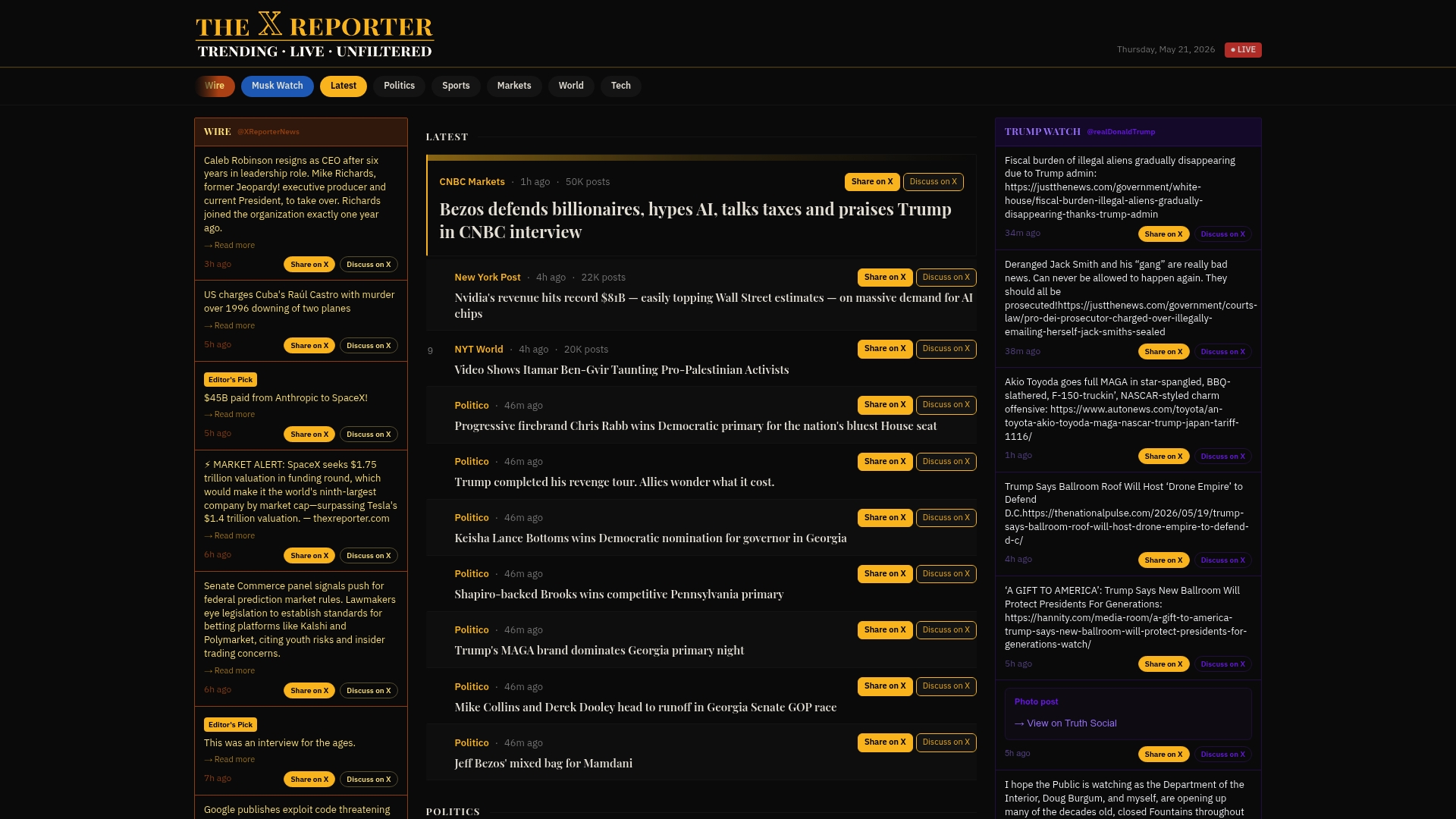
Maintaining a daily news briefing checklist is significantly easier when your source monitoring is handled efficiently. Thexreporter delivers real-time trending news across politics, tech, and markets, giving journalists and news professionals a single, reliable starting point for their daily scan. The platform distills high-volume news flows into concise editorial summaries, reducing the time spent on source-tier scanning and making it easier to populate your briefing with verified, audience-relevant content. For teams following a structured newsletter workflow, Thexreporter integrates naturally into the intake phase of daily briefing preparation.
FAQ
What is a daily news briefing checklist?
A daily news briefing checklist is a structured set of editorial steps, covering source scanning, story selection, verification, summarization, and publishing review, used by journalists to prepare accurate and timely news summaries each day.
How long should briefing prep take?
Research supports a 15 to 20 minute timed prep window. A strict timer prevents prep drift and forces decisive editorial choices aligned with Parkinson's Law.
How many stories should a daily briefing include?
Most effective briefing routines recommend 3 to 5 focus stories. This range maintains editorial depth while keeping the briefing readable and manageable for both producers and audiences.
Why is a local angle required in a briefing?
Local content drives higher engagement than national wire summaries alone. Including at least one audience-specific or regional story differentiates a briefing and increases repeat readership.
How should unverified stories be handled in a briefing?
Label them explicitly in your CMS as unverified or draft, and require human editorial approval before publication. Marking uncertain stories clearly prevents misinformation from entering published content during fast-moving news cycles.