

Most people assume a news roundup is just a list of headlines thrown together at the end of the day. That assumption undersells what a well-produced roundup actually does. A news roundup is a curated editorial product that distills the most significant developments across one or more subject areas into a concise, digestible format. It saves time, reduces information overload, and helps readers stay oriented without tracking dozens of sources. This guide covers the news roundup meaning, the formats it takes, its real benefits, and how it gets made.
Table of Contents
- Key takeaways
- What is a news roundup, defined
- Types and formats across sectors
- Benefits of news roundups for everyday readers
- How a news roundup gets created
- News roundup examples worth knowing
- My perspective on news roundups today
- Stay ahead with Thexreporter
- FAQ
Key takeaways
| Point | Details |
|---|---|
| Clear definition | A news roundup is a curated summary of multiple news items, not a simple list of headlines. |
| Format variety | Roundups appear as daily podcasts, weekly email digests, and video segments across general and niche sectors. |
| Time-saving purpose | Roundups help readers absorb major developments quickly without following every source individually. |
| Editorial pipeline matters | Reliable roundups follow a repeatable collect, enrich, and select process to maintain consistency. |
| Broad applications | Both general audiences and professionals use roundups to stay current in politics, markets, technology, and more. |
What is a news roundup, defined
The word "round-up" in journalism functions as a noun meaning a summary of news, information, or events. A news roundup, by extension, is a short report or collection that brings together multiple news items under a single editorial product. The format is designed to give readers a concise map of recent developments without requiring them to seek out each story individually.
A news roundup is not a raw news feed. It is an editorial selection. The difference lies in the judgment applied to deciding which stories matter and how they are presented.
News roundups have roots in broadcast journalism, where daily wrap-up segments became a fixture of radio and television programming. The format carried forward into the digital era with few structural changes. What changed is the delivery method and the speed of publication. Today, roundups appear in multiple recurring forms:
- Daily roundups: Published every morning or evening, covering the most significant headlines from the past 24 hours.
- Weekly roundups: Broader in scope, often including context and analysis that daily formats skip.
- Sector-specific roundups: Focused on a single domain such as politics, technology, markets, or health.
- Multi-segment roundups: Broadcast-style products with distinct blocks covering different topic areas.
The CBS News Roundup podcast is one of the most recognized examples of this format in practice, offering weekday morning and evening segments alongside a weekend edition that features deeper dives into social justice and broader cultural topics.
Types and formats across sectors
Not every news roundup covers the same ground, and that range is one of its most useful qualities. General news roundups try to capture the most consequential stories across politics, economics, science, and culture. Niche roundups narrow that scope considerably, addressing readers who need depth in one area rather than breadth across many.
| Format type | Scope | Delivery method | Frequency |
|---|---|---|---|
| General news roundup | Politics, markets, science, culture | Podcast, newsletter, website | Daily or weekly |
| Vertical niche roundup | Single sector (e.g., tech, health) | Email digest, blog post | Weekly or biweekly |
| Broadcast segment | Wide-ranging topics | Video, audio | Daily |
| Curated newsletter | Selected headlines with commentary | Weekly |
Niche roundups have grown considerably as readers demand more focused coverage. A clear example is the longevity technology news space, where dedicated weekly roundups summarize developments in aging science, biotech investments, and clinical research. Readers in that space do not want to filter through general technology coverage. They want the specific slice.
Newsletter and podcast delivery formats now dominate how roundups reach audiences. Each method serves a different consumption habit. Podcasts reach commuters and multitaskers. Email digests reach professionals who prefer reading at a desk. Web-based roundups serve readers who browse on demand.

Pro Tip: If you want to use a news roundup professionally, match the format to your workflow. If you have 10 minutes during a commute, a podcast roundup works better than a long-form email digest you will not finish.
Benefits of news roundups for everyday readers
The practical value of a well-designed news roundup is measurable. Readers who follow curated roundups rather than unfiltered feeds report less anxiety about missing important stories, because roundups orient readers around the headlines that actually moved the conversation.
Here are the four primary benefits news roundups provide:
- Time efficiency. A roundup condenses hours of potential news reading into a five to ten minute format. Readers absorb the essentials without visiting multiple outlets.
- Reduced news fatigue. Constant alerts and feeds create cognitive overload. A curated roundup replaces that noise with a structured, finite summary. You read it once and you are done.
- Contextual clarity. Good roundups do not just list what happened. They briefly explain why it matters. That context is what separates a roundup from a raw headline aggregator.
- Sector-specific efficiency. Professionals in finance, law, or healthcare can rely on vertical roundups to track developments relevant to their work without wading through unrelated news.
For readers who struggle to catch up on missed news, a well-timed roundup is one of the most reliable tools available. It covers the gap between what happened and what you know without requiring a complete replay of the news cycle.
How a news roundup gets created
Understanding the editorial pipeline behind a roundup helps readers evaluate its quality. A roundup that feels authoritative and consistent is almost always the product of a repeatable editorial workflow, not an ad hoc collection of links.
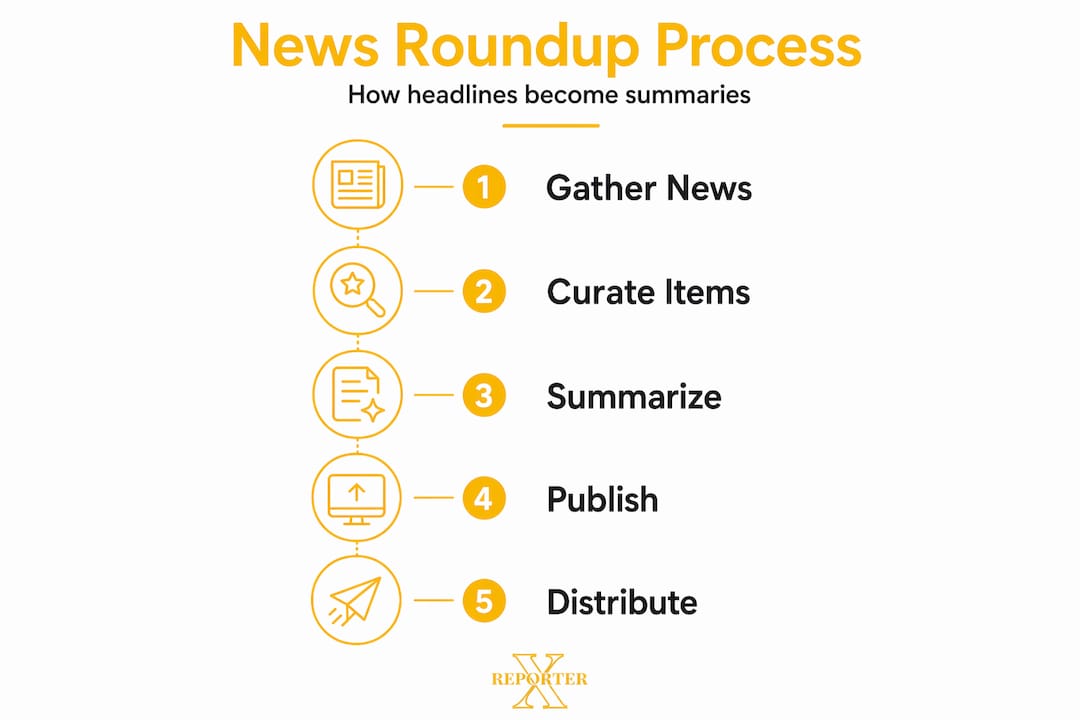
The standard production process includes these steps:
- Source aggregation: Editors or automated systems pull headlines and articles from a defined set of trusted sources. The source list determines the roundup's coverage scope and reliability.
- Content enrichment: Each selected item is reviewed for accuracy, recency, and relevance. In some cases, brief commentary or context is added to clarify the story's significance.
- Editorial selection: Not every aggregated item makes the final roundup. Editors apply judgment to prioritize stories based on impact, newsworthiness, and audience relevance.
- Scheduled publication: Consistent timing matters. Readers who rely on a daily roundup expect it at the same time each day. Irregular publication erodes audience trust.
Pro Tip: When evaluating any news roundup, check whether it discloses its sources. A roundup without a clear editorial methodology is harder to trust than one that names its source pool.
Editorial curation is what separates a quality roundup from a content dump. The balance between being comprehensive enough to feel complete and selective enough to respect the reader's time is the defining challenge of roundup production.
News roundup examples worth knowing
Several established roundups illustrate how the format works across different contexts. Readers who want to see the format in action can explore these directly:
- CBS News Roundup: One of the longest-running broadcast formats, available as a podcast with morning, evening, and weekend segments covering U.S. and international news.
- Jon Ward's Weekly News Roundup: A Substack-based digest designed for readers who may only have time to scan headlines, offering a curated selection of the week's key political stories.
- Longevity Technology Weekly Roundup: A niche product covering biotech and aging science for a specialized professional audience.
- Newsletter-based roundups: Platforms like Venngage provide structured templates for organizations that want to produce their own branded news roundups for internal or external audiences.
Each of these represents a different audience, cadence, and editorial philosophy. What they share is the same core function: organized, curated, and reliable access to recent news.
My perspective on news roundups today
I've watched the media environment grow more fragmented over the past decade, and the case for editorial curation has only gotten stronger as a result. Raw news feeds reward speed over accuracy. Social platforms reward engagement over substance. A good news roundup, by contrast, rewards judgment.
What I find most underappreciated about well-produced roundups is how they function as a trust signal. When a roundup consistently covers the same domain, applies the same editorial standards, and publishes on schedule, it builds the kind of reader relationship that scattered news consumption never achieves. I rely on two or three vertical roundups every week, and they account for most of what I know about sectors outside my primary focus.
The pitfall I've seen most often is roundups that prioritize volume over selectivity. A roundup with 40 items is not more valuable than one with 8. It is harder to use. The best roundup producers understand that saying no to a story is as important as choosing to include one. Understanding how news goes viral does not automatically make a story roundup-worthy. Importance and virality are not the same metric.
— Trevor
Stay ahead with Thexreporter
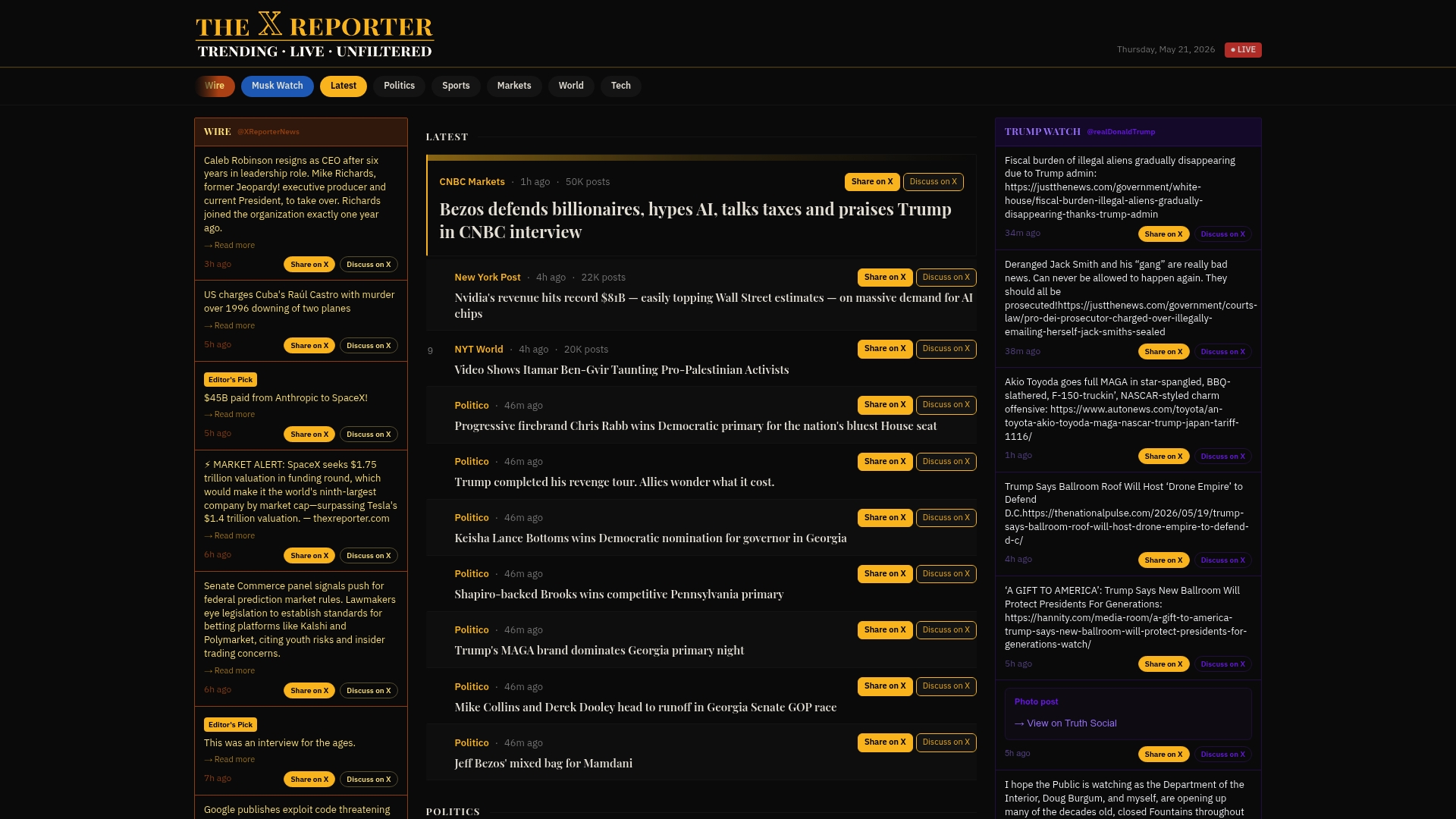
Thexreporter delivers exactly what a news roundup should: timely, curated editorial summaries across politics, technology, and markets, without the noise of unfiltered feeds. The platform applies a consistent editorial process to surface the stories that matter, giving readers a structured and reliable daily resource. Whether you follow breaking political developments, track market movements, or monitor technology shifts, Thexreporter organizes the information so you do not have to. Explore trending live news updated throughout the day and see how a well-executed roundup format changes how efficiently you stay informed.
FAQ
What does "news roundup" mean?
A news roundup is a curated editorial summary of multiple recent news items, drawn from various sources and organized into a concise format for efficient consumption.
How is a news roundup different from a newsletter?
A news roundup focuses specifically on summarizing recent headlines, while a newsletter may include editorial commentary, promotions, or longer feature content beyond current events.
What should a news roundup include?
A strong news roundup includes selected headlines from credible sources, brief context explaining each item's significance, and consistent publication on a defined schedule.
How often are news roundups published?
News roundups appear on daily, weekly, or biweekly schedules depending on the format. Daily roundups cover the past 24 hours, while weekly editions offer broader context across the full week.
Can a news roundup focus on a specific sector?
Yes. Many roundups specialize in a single domain such as health technology, financial markets, or political affairs, providing deeper coverage for audiences with focused professional or personal interests.