

Understanding how news goes viral is not simply a matter of tracking shares and clicks. False news spreads farther, faster, and deeper than true news, a finding that challenges the intuitive assumption that quality and accuracy drive reach. Human psychology, not automated bots, is the primary engine. This article breaks down the core mechanisms, psychological triggers, algorithmic forces, and practical strategies that explain why certain stories explode across platforms while others disappear within hours.
Table of Contents
- Key Takeaways
- How news goes viral: the core mechanics
- The diffusion phases of viral news
- Psychological and social factors in viral sharing
- Managing viral news: pitfalls and best practices
- My take on virality and what it actually means
- Stay ahead with Thexreporter
- FAQ
Key Takeaways
| Point | Details |
|---|---|
| False news travels faster | Research confirms false stories spread farther and more broadly than accurate ones across social platforms. |
| Emotions drive sharing | Fear, outrage, and surprise trigger sharing behavior far more reliably than neutral or positive content. |
| Algorithms amplify belief alignment | Platforms accelerate content that matches users' existing beliefs, compressing the spread timeline. |
| Repetition distorts perceived truth | Repeated exposure to a false claim increases how credible it feels, even without new evidence. |
| Inoculation reduces susceptibility | Preemptive exposure to manipulation tactics measurably improves resistance to misinformation. |
How news goes viral: the core mechanics
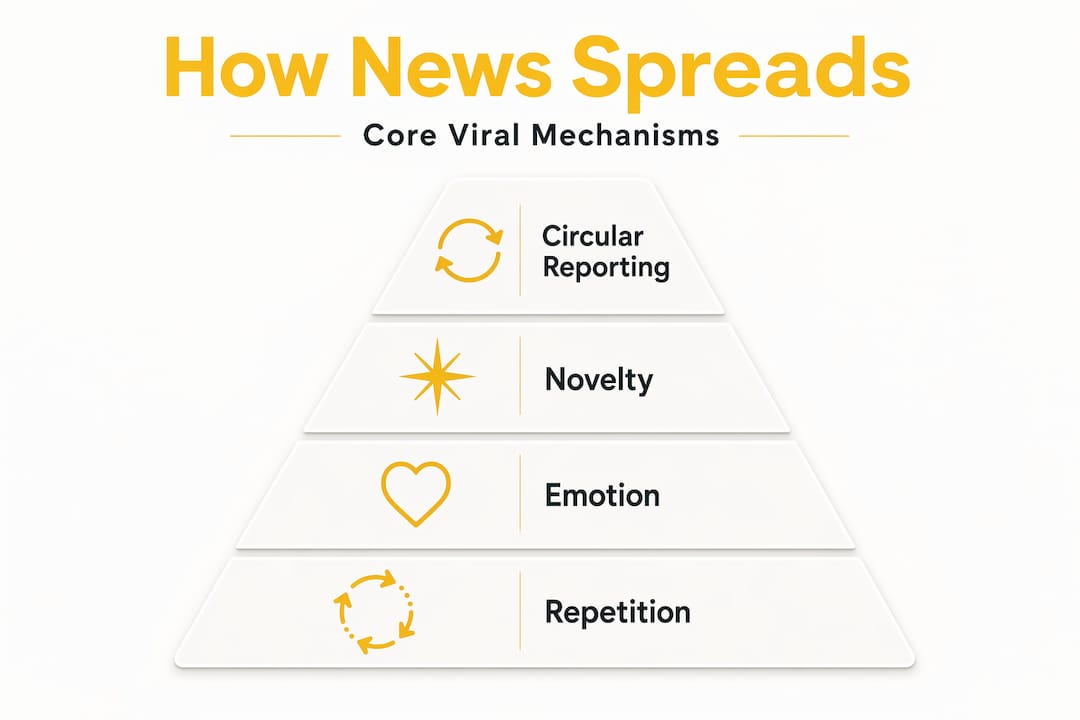
The foundational question is not why people share news, but what overrides their skepticism when they do. Three forces consistently appear at the center of viral diffusion: novelty, emotional intensity, and repetition.
Novelty is the entry point. Content that presents information people have not encountered before generates a measurable spike in attention and motivation to pass it along. This is why breaking news, unexpected revelations, and counterintuitive claims spread before verification catches up. The information feels urgent precisely because it is new.
Emotional intensity is the accelerant. Strong emotions like outrage, fear, and disgust trigger sharing at significantly higher rates than neutral or positive content. False news in particular tends to evoke fear and surprise, which explains a substantial portion of its diffusion advantage. When a story makes someone feel threatened or morally violated, the impulse to share functions almost as a warning signal to their network.
Repetition, however, is the most underappreciated factor. A meta-analysis of 182 studies covering more than 31,000 participants confirmed that repeated exposure to false information increases its perceived truth, with an effect size of g = 0.37. This is the illusory truth effect, and it operates even when people are explicitly told a claim is false. Familiarity is processed as credibility.
One additional mechanism deserves attention: circular reporting, where misinformation gets cited across multiple outlets as if it were independently verified. Each citation adds apparent legitimacy, regardless of the original source's reliability. This cycle can persist for weeks before corrections gain traction.
Pro Tip: When you encounter a story that multiple outlets are covering simultaneously, check whether they are all tracing back to the same original source. Circular reporting can make a single unverified claim look like consensus.
A critical point that research has clarified: robots accelerated true and false news equally, but humans preferentially share falsehoods. The spread of viral misinformation is fundamentally a human behavior problem, not a bot problem.
The diffusion phases of viral news
Viral spread does not happen in one continuous wave. It follows a staged process that researchers have mapped using Rogers' Diffusion of Innovation framework adapted to misinformation dynamics.

The four phases break down as follows:
| Phase | Description | Key Driver |
|---|---|---|
| Introduction | Initial seeding across a small network | Novelty and shock value |
| Acceleration | Rapid sharing across broader audiences | Algorithmic amplification and emotional resonance |
| Saturation | Peak reach across the network | Community re-sharing and identity expression |
| Stabilization | Lingering audience engagement | Repeated exposure and belief reinforcement |
Misinformation virality follows this staged diffusion process, with algorithmic amplification playing a decisive role during the acceleration phase. Platforms surface content that aligns with users' existing beliefs, which compresses the time between introduction and saturation. A story that would have taken days to spread organically can reach millions within hours when the algorithm treats engagement as a quality signal.
The stabilization phase is often overlooked in discussions about viral news. Stories do not simply fade after peak reach. They persist in specific communities that continue to re-share them in new contexts, sometimes months after the original publication. This long tail of virality means that corrections issued at peak saturation may never reach audiences who encounter the story later.
Early adopters in this model are not tech enthusiasts. They are users whose existing beliefs make them immediately receptive to a story's framing. Late adopters join when the content has accumulated enough social proof through likes, comments, and re-shares to feel credible by volume alone.
Psychological and social factors in viral sharing
The psychological architecture behind viral news sharing is more specific than general emotional reactivity. Several distinct mechanisms interact to determine who shares what and why.
Emotional manipulation tactics are the most direct. Outrage, anger, and scapegoating are not accidental features of viral misinformation. They are structural elements that make content feel personally relevant and morally urgent. When a story assigns blame to a clear target, it gives the reader both an explanation and an outlet.
Partisan bias compounds this effect. People with strong political identities are more likely to accept and share content that confirms their worldview, even when they encounter signals that the content may be inaccurate. Analytical thinking style matters here. Research consistently shows that individuals who pause to evaluate evidence before sharing are less susceptible to misinformation, regardless of their political orientation.
Social identity and stance attachment represent a particularly powerful amplification mechanism. Re-sharing content is not just information transfer. It is a public declaration of identity. When a story allows users to signal group membership or moral position quickly, the sharing rate increases substantially. This is why content framed around "us versus them" dynamics spreads faster than neutral reporting on the same underlying facts.
Pro Tip: Before sharing a story that makes you feel strongly about a group or political figure, ask whether you are sharing information or expressing identity. That distinction changes how critically you evaluate the source.
Psychological inoculation campaigns offer a measurable counter to these dynamics. Studies on inoculation videos targeting manipulation tactics showed approximately a 5% improvement in recognition of manipulative techniques among viewers. That figure sounds modest, but applied across millions of platform users, it represents a meaningful reduction in susceptibility. The mechanism works by exposing people to weakened forms of manipulative arguments before they encounter them at full force.
Managing viral news: pitfalls and best practices
The instinct to counter viral misinformation by repeating and debunking it is understandable. It is also frequently counterproductive.
The illusory truth effect creates a specific risk for debunking efforts. Careless repetition during corrections can increase familiarity with the false claim even when the surrounding context is clearly corrective. Audiences process the claim itself more fluently after each exposure, and that fluency registers as credibility. The correction gets forgotten; the claim persists.
Effective corrections follow a different structure. They emphasize veracity cues, meaning clear signals about what is true rather than extended engagement with what is false. Framing matters as much as content. A correction that leads with accurate information and briefly addresses the false version outperforms one that leads with the false claim and then refutes it.
Here are the most evidence-supported practices for individual media consumers:
- Check the original source before sharing, not just the headline or the outlet that picked it up.
- Pause when a story produces strong emotional reactions. Outrage and fear are reliable signals to slow down, not speed up.
- Search for coverage from multiple independent outlets before treating a claim as confirmed.
- Engage with media literacy resources that explain manipulation tactics, not just fact-check databases.
- Recognize that early exposure and mindful reflection on truthfulness reduce susceptibility more than post-hoc corrections.
Pro Tip: Media literacy is not about being skeptical of everything. It is about knowing which questions to ask first. Start with: who benefits if this story spreads?
The role of platform design in this equation cannot be ignored. Sharing mechanisms that allow users to quickly express stance, such as one-click re-shares with emotional reaction options, are structurally optimized for virality over accuracy. Understanding what makes news shareable at the design level helps explain why even well-informed users share misinformation.
My take on virality and what it actually means
I have spent years watching how stories spread, and the pattern that stands out most is how rarely virality reflects importance. The stories that travel farthest are not the ones that matter most. They are the ones that trigger the fastest emotional response in the largest number of people simultaneously.
What conventional wisdom gets wrong is the assumption that better information automatically corrects the problem. I have seen highly accurate, well-sourced stories fail to gain traction while demonstrably false ones circulate for months. The difference is almost never about truth. It is about how quickly a story lets someone feel something and act on it.
The subtlest lesson I have taken from watching this play out is about early exposure. The first version of a story a person encounters sets the frame for everything they read afterward. If that first version is false or distorted, corrections face an uphill battle against the familiarity effect. This is why misinformation virality is a coupled human-algorithmic phenomenon and not simply a technology problem. The algorithm surfaces content, but the human decides what feels true.
Credible storytelling does have resilience. Stories grounded in verifiable specifics, transparent sourcing, and measured framing build a different kind of trust over time. That trust does not generate the same immediate spike, but it compounds. The readers who develop habits of mindful sharing become the most valuable nodes in any information network.
— Trevor
Stay ahead with Thexreporter
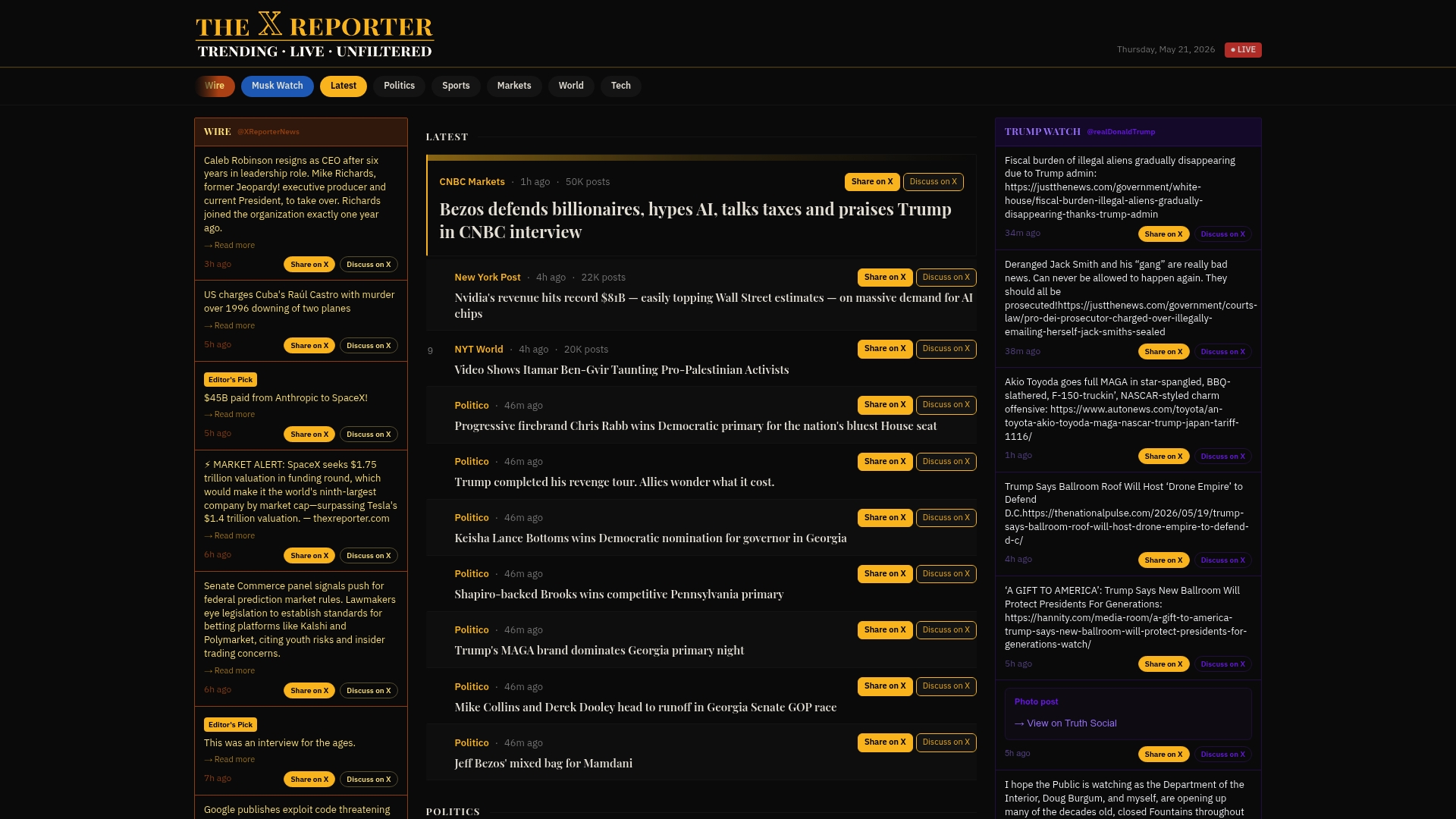
Viral news cycles move fast, and staying oriented requires more than a social media feed. Thexreporter aggregates trending, live, unfiltered news with brief editorial context on breaking stories, so you get the signal without the noise. Whether you are tracking a developing story or catching up on the day's most significant coverage, the platform is built for readers who want substance alongside speed. For anyone serious about understanding how stories spread online and what drives the news cycle on any given day, Thexreporter provides a reliable starting point. Explore the latest coverage and use it alongside the critical frameworks in this article to assess what you are reading before you share it.
FAQ
Why does false news spread faster than true news?
False news spreads farther and faster primarily because it tends to be more novel and emotionally provocative than accurate reporting. Human users, not bots, drive this disparity by preferentially sharing content that surprises or outrages them.
What emotions most drive viral news sharing?
Fear, outrage, and disgust are the most reliable drivers of viral sharing behavior. These emotions create a sense of urgency that overrides the deliberation users might otherwise apply before passing content along.
What is the illusory truth effect in news virality?
The illusory truth effect is the tendency for repeated exposure to a claim to increase its perceived credibility. A meta-analysis of over 31,000 participants confirmed this effect, which is why debunking efforts that repeat false claims can inadvertently strengthen them.
Can individuals build resistance to viral misinformation?
Yes. Inoculation campaigns targeting manipulation tactics have shown measurable improvements in people's ability to recognize misinformation techniques. Pausing before sharing and checking original sources are the most consistently effective individual behaviors.
How do algorithms contribute to viral news spread?
Algorithms accelerate content that aligns with users' existing beliefs and generates high engagement signals. This amplification compresses the natural diffusion timeline, moving stories from introduction to saturation far faster than organic network spread alone would allow.