

Not all international news is created equal. The types of international news stories you encounter daily range from raw, real-time dispatches to months-long investigative reports, and each format serves a fundamentally different purpose. Readers who treat them as interchangeable often misread the reliability, depth, and intent behind what they consume. Understanding these distinctions is one of the most practical skills any engaged global citizen can develop. This guide breaks down the major categories of global news so you can read more critically and confidently.
Table of Contents
- Key takeaways
- 1. Breaking news stories in international coverage
- 2. Investigative journalism in international news
- 3. Feature and narrative journalism for global stories
- 4. Data journalism and its rising role in international reporting
- 5. Opinion and broadcast news as distinct international news types
- My take on why recognizing news types matters more than ever
- Stay informed with Thexreporter
- FAQ
Key takeaways
| Point | Details |
|---|---|
| News types serve different purposes | Breaking, investigative, feature, data, opinion, and broadcast news each carry distinct editorial standards. |
| Speed affects accuracy | Breaking news prioritizes immediacy, which increases the risk of early errors that require later corrections. |
| Sourcing signals story depth | Wire-reliant stories differ sharply from original-interview-based features and investigations. |
| Data journalism is formally recognized | The Pulitzer Prize Board treats data-driven reporting as its own distinct journalistic format. |
| Opinion requires explicit labeling | Opinion content does not require factual neutrality but must be clearly separated from news reporting. |
1. Breaking news stories in international coverage
Breaking news is the most immediate type of international news story. It covers events as they unfold, from military conflicts and natural disasters to diplomatic crises and election results. The defining characteristic is speed. Reporters and editors prioritize getting accurate core facts published before competitors, often within minutes of an event occurring.
The sourcing structure for breaking news is distinct from other formats. Wire services like AP and Reuters are the primary engines, transmitting dispatches globally within seconds of a development. Official government statements, press releases, and emergency agency bulletins round out the initial sourcing. This reliance on institutional sources means breaking news reflects official narratives more than ground-level reality, at least initially.
The trade-off is clear. Breaking news carries a higher risk of initial errors, with corrections issued post-publication as new information emerges. Early casualty figures in conflict zones, for example, are frequently revised. Readers who understand this dynamic are less likely to treat first-hour reports as definitive.
Common examples of international breaking news include:
- Sudden military escalations or ceasefires
- Major election results and political transitions
- Natural disasters such as earthquakes or tsunamis
- Diplomatic expulsions or sanctions announcements
- Terrorist attacks or mass casualty events
Pro Tip: When consuming breaking international news, treat the first two hours of coverage as provisional. Cross-reference at least two wire services and check for updates before forming conclusions.
2. Investigative journalism in international news
Investigative journalism sits at the opposite end of the production timeline from breaking news. These reports take weeks, months, or even years to complete. The highest threshold before publication applies here, requiring multiple independent sources, document verification, and corroboration of every significant claim.

The subject matter tends to involve systemic failures, corruption, or hidden misconduct that institutions prefer to conceal. The Panama Papers, a cross-border investigation involving over 400 journalists and 11 million leaked documents, exemplifies what international investigative journalism can achieve. The Pandora Papers followed a similar model, exposing offshore financial networks across dozens of countries.
What distinguishes this format from others is its originality. Investigative teams do not rely on wire services or press conferences. They build their own source networks, file freedom-of-information requests, analyze financial records, and conduct on-the-record interviews with whistleblowers and officials alike.
Key characteristics of investigative international journalism:
- Extended production timelines, often spanning months
- Document-based verification as a core standard
- Focus on systemic issues rather than single events
- Collaboration across newsrooms in multiple countries
- High legal and personal risk for reporters in authoritarian contexts
For readers, investigative pieces carry the highest evidentiary weight of any news format. They represent original contributions to public knowledge rather than repackaged official information.
3. Feature and narrative journalism for global stories
Feature journalism occupies the space between breaking news and investigative reporting. It is not reactive, and it is not necessarily exposing wrongdoing. Instead, it uses narrative techniques, reported scenes, and interviews to provide context, texture, and human meaning to international events.
A feature story on the Syrian refugee crisis, for example, might follow a single family across three countries over six months. The goal is not to break a new development but to help readers understand what a global trend actually feels like at the human level. This format is particularly effective for covering cultural shifts, social movements, and long-term consequences of policy decisions.
Production timelines for features are moderate, typically ranging from days to several weeks. Reporters rely heavily on original interviews and on-the-ground reporting rather than wire feeds. The writing style is more literary than a news brief, using scene-setting and character development to sustain reader engagement across longer formats.
Characteristics of strong international feature writing:
- Grounded in specific individuals, places, or events rather than abstractions
- Rich with contextual background that explains the "why" behind a story
- Structured with a narrative arc rather than an inverted pyramid
- Bridges immediate news events with broader social or cultural analysis
Pro Tip: Quality feature writing always answers a question the breaking news story left open. If a feature does not add context or human dimension beyond what a wire report already covered, it is not doing its job.
4. Data journalism and its rising role in international reporting
Data journalism has grown substantially as a recognized format within international news coverage. It uses structured datasets, public records, and computational analysis to produce reports that reveal patterns invisible to traditional reporting methods. The Pulitzer Prize Board recognizes data-driven reporting as a distinct journalistic category, which reflects how seriously the industry now treats this format.
Common applications in international contexts include tracking conflict casualties using verified incident databases, mapping economic inequality across regions, analyzing voting patterns in foreign elections, and visualizing the spread of disease across borders. The New York Times and The Guardian have both produced landmark international data journalism projects that shifted public understanding of global issues.
| Data journalism topic | Common data sources | Output format |
|---|---|---|
| Conflict casualties | ACLED, UN reports | Interactive maps, charts |
| Economic indicators | World Bank, IMF datasets | Trend analysis, graphs |
| Health statistics | WHO, national health ministries | Comparative tables, timelines |
| Climate data | NOAA, Copernicus | Visualizations, projections |
Data journalism supplements traditional reporting by providing empirical grounding for claims that might otherwise rely on anecdote or official assertion. It also allows readers to examine the underlying data directly, which adds a layer of transparency not available in other formats.
5. Opinion and broadcast news as distinct international news types
Opinion and broadcast formats are two of the most consumed yet frequently misunderstood categories of international stories. Each plays a legitimate role in global news ecosystems, but both require a different interpretive framework from readers.
Opinion pieces express explicit viewpoints on international events. They do not require factual neutrality, though any embedded factual claims must meet accuracy standards. Press councils and editorial boards track compliance. The key reader obligation is recognizing that an opinion column on, say, U.S.-China trade policy reflects the author's analytical framework, not a neutral account of events. Quality opinion writing is clearly labeled and draws on verifiable facts to support its arguments.
Broadcast news, covering television and radio formats, often blends multiple news types within a single program. A 30-minute international news broadcast might include a breaking news segment, a feature package, and an opinion panel, all presented in sequence. Globalization and commercial pressures have accelerated this blending, as broadcasters compete for audience attention across shorter segments. Understanding which segment type you are watching at any given moment is a practical media literacy skill.
The distinction matters because audience expectations differ sharply. Viewers who treat opinion panels as factual reporting, or who mistake a feature package for breaking news, are likely to misread the authority and scope of what they are seeing.
My take on why recognizing news types matters more than ever
I've spent years reading and analyzing international coverage across dozens of outlets, and the single most consistent problem I see is readers treating all news as functionally equivalent. A wire brief and a six-month investigation are not the same thing. Consuming them as if they were is how misinformation takes hold.
What I've found is that sourcing distinctions are the fastest diagnostic tool available. Ask where the information came from. If a story cites only official statements and wire feeds, it is likely breaking news with all the limitations that entails. If it cites original documents, named whistleblowers, and cross-border research, you are reading something with far greater evidentiary weight.
The uncomfortable truth is that commercial pressures reshaping international journalism are reducing the volume of original foreign correspondence. More outlets now depend on wire services for international coverage than at any prior point. That makes it harder to find deep, original reporting on global events, but it also makes it more valuable when you do find it. Knowing the difference is not an academic exercise. It is a practical defense against being misled.
— Trevor
Stay informed with Thexreporter
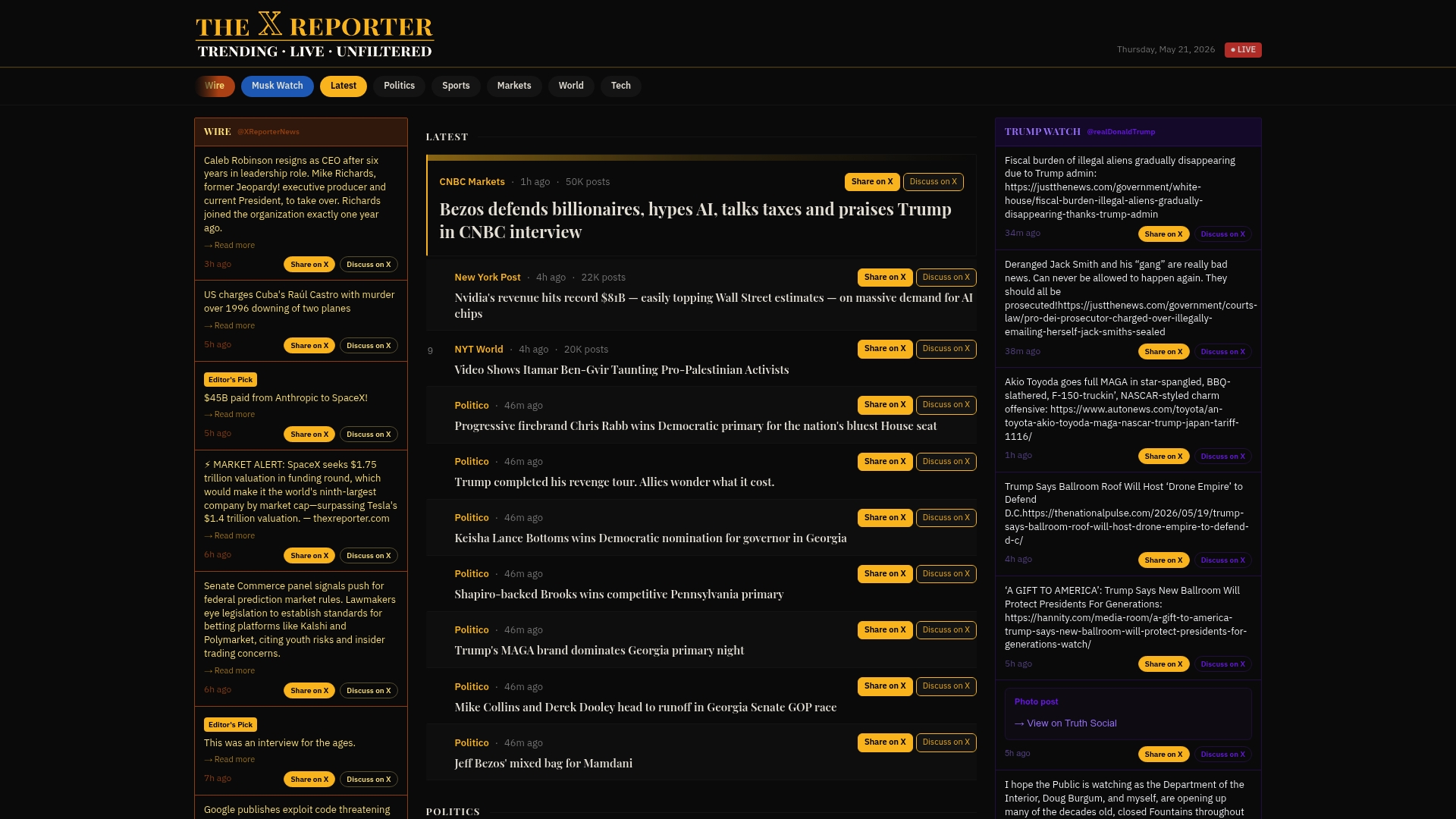
Thexreporter is built for readers who want to apply exactly this kind of critical framework to live global news. The platform aggregates real-time international coverage across breaking news, politics, markets, and technology, delivering concise editorial summaries that preserve the context most aggregators strip away. Rather than presenting a raw feed of wire dispatches, Thexreporter curates stories with the sourcing and format distinctions that help you read more intelligently. If you want to stay current on international news topics without losing the analytical thread, this is where to start.
FAQ
What are the main types of international news stories?
The main types are breaking news, investigative journalism, feature journalism, data journalism, opinion content, and broadcast news. Each format follows distinct editorial standards and serves a different informational purpose.
How does breaking news differ from investigative journalism?
Breaking news prioritizes speed and relies on wire services, carrying a higher risk of early errors. Investigative journalism requires extended research, multiple independent sources, and document verification before publication.
Why does it matter which type of international news I am reading?
Different news types carry different levels of verification and depth. Recognizing the format helps you assess the reliability of the information and the editorial standards applied to it.
What is data journalism in international news?
Data journalism uses structured datasets and computational analysis to reveal patterns in global events. The Pulitzer Prize Board recognizes it as a distinct journalistic format, separate from traditional reporting.
How can I verify international breaking news quickly?
Cross-referencing multiple wire services and checking academic or library databases that aggregate international sources provides the most reliable early verification for breaking global events.