

Local news is defined as the primary civic infrastructure connecting residents to the decisions, institutions, and events that directly shape their daily lives. National outlets cover Washington and Wall Street. Local newsrooms cover your school board, your zoning board, and your water supply. That distinction is not trivial. 80% of U.S. adults say local news outlets are somewhat important to community well-being, yet only 34% rate them as extremely or very important, down from 44% in 2024. That gap between recognition and prioritization is exactly why the importance of local news deserves a direct, evidence-based examination.
Why local news matters for civic participation
Local journalism is the primary source citizens use to learn about public hearings, zoning changes, school board votes, and municipal budget decisions. No national outlet covers a county commissioner meeting in rural Ohio or a rezoning proposal in suburban Georgia. That coverage gap has measurable consequences.
Research from Yale Insights shows that weakening newspaper notice requirements produced a 37% reduction in public notices and a direct drop in citizen participation at government meetings. Counties that moved notices to government websites saw 14% to 18% fewer meeting speakers compared to counties that kept newspaper publication. This finding matters because it proves that distribution channel is not a neutral variable. Residents rely on familiar, trusted channels. Moving information to a website does not preserve awareness; it quietly erodes it.
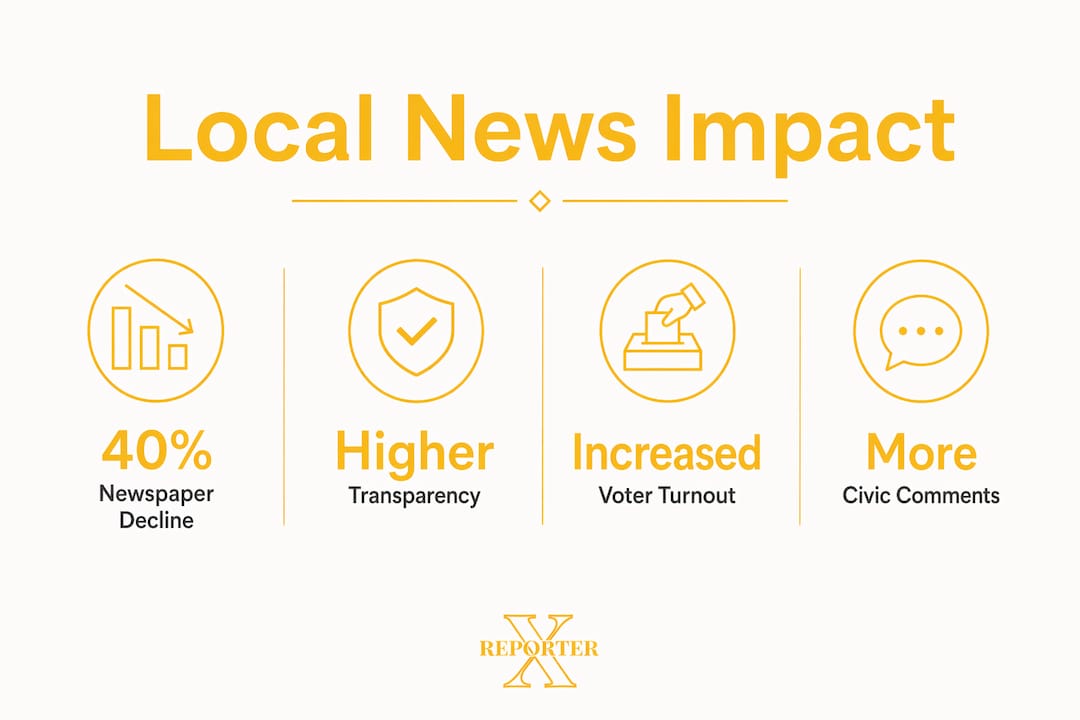
The benefits of community journalism extend beyond attendance counts. When residents receive consistent, accurate information about local government actions, they ask better questions, submit more public comments, and vote in local elections at higher rates. The American Press Institute frames this as civic on-ramps, behavioral signals like repeat participation and public use of journalism that measure civic health more accurately than audience size alone.
- Local newspapers publish public notices for hearings, zoning, and permits that government websites fail to replicate in reach
- Voter turnout and meeting attendance correlate directly with local news access in studied counties
- Digital-only notice systems do not compensate for the loss of print distribution in civic awareness
Pro Tip: If you want to track local government decisions before they affect your neighborhood, subscribe to your local paper's public notice section or set a Google Alert for your city council's name combined with "agenda."
How local news holds local authorities accountable
The watchdog function of local journalism is the role of local news in society that most directly protects democratic governance. Investigative reporting at the local level exposes contract irregularities, mismanaged public funds, and conflicts of interest that would otherwise go unnoticed for years.

Research published by the UK government found that local news increases transparency by training officials toward proactive accountability. Approximately half of local officials surveyed agreed that local journalism raises governance standards, not just by catching wrongdoing after the fact, but by creating an environment where officials anticipate scrutiny. That anticipatory effect is the less-discussed benefit of a healthy local press.
The contrast between communities with active local newsrooms and those without is stark.
| Condition | Governance outcome |
|---|---|
| Active local newsroom present | Higher transparency, more proactive disclosure, lower corruption risk |
| Reduced local coverage | Fewer public notices, less official accountability, lower meeting attendance |
| News desert (no local outlet) | Misinformation spread, weakened civic trust, economic decline risk |
The news verification standards that professional local journalists apply are precisely what separates accountability reporting from social media speculation. When a local reporter files a public records request, the resulting story carries legal and factual weight that a Facebook post cannot replicate.
Pro Tip: When evaluating a local news outlet's accountability reporting, check whether the story cites public records, named officials, or on-record sources. These markers distinguish verified journalism from unverified claims.
How local news shapes communities and social cohesion
The social cohesion benefits of strong local news go beyond politics. Local journalism creates shared community narratives, establishes civic norms, and gives residents a common factual foundation for public debate. That shared foundation is what makes constructive disagreement possible.
Research confirms that local news fosters civic norms and constructive public dialogue by amplifying diverse voices and reducing the social tensions that misinformation generates. When a community has no reliable local outlet, social media fills the vacuum. The result is fragmented, emotionally charged information that divides rather than informs. Traditional media's foundational role in supporting civic culture has been documented across multiple countries and contexts, confirming that this is not a uniquely American dynamic.
- Local news provides a shared factual baseline that reduces neighbor-to-neighbor misinformation
- Coverage of community events, local businesses, and neighborhood issues builds social trust
- Diverse voices in local reporting reflect the actual composition of a community, not just its loudest factions
- Local journalism reduces the influence of national partisan narratives on purely local decisions
Why community news is essential is not a sentimental argument. It is a structural one. Communities without shared information sources fragment along social media fault lines, making collective decision-making slower, more contentious, and less informed.
What the decline of local news means for your community
The scale of local news decline in the United States is significant. Since 2002, local newspapers have declined by nearly 40%, and local journalist counts have dropped over 75%. Approximately 50 million Americans now live in communities with limited access to reliable local reporting. Syracuse University launched the Local News Research Hub in 2026 specifically to consolidate and accelerate research on these impacts.
| Metric | Data point |
|---|---|
| Local newspaper decline since 2002 | Nearly 40% reduction in outlets |
| Local journalist reduction | Over 75% drop in headcount |
| Americans with limited local news access | Approximately 50 million |
| Adults rating local news as very important | 34% in 2025, down from 44% in 2024 |
The rise of digital and online-only sources has partially offset print losses, but the replacement is uneven. Digital outlets tend to concentrate in urban areas, leaving rural and lower-income communities most exposed to news desert risks. Those risks include lower civic engagement, weakened government accountability, and greater susceptibility to misinformation. The hyperlocal news model has emerged as one response, focusing coverage on specific neighborhoods or municipalities that larger outlets have abandoned.
The declining perception of local news importance among Americans compounds the structural problem. When residents do not value local journalism, they do not subscribe, donate, or advocate for it. That reduced financial support accelerates the closures it reflects.
Key takeaways
Local news is civic infrastructure, and its decline directly reduces transparency, civic participation, and community cohesion in measurable, documented ways.
| Point | Details |
|---|---|
| Civic participation depends on local news | Counties losing newspaper public notices saw up to 18% fewer meeting speakers. |
| Watchdog function shapes governance quality | About half of local officials agree local journalism raises transparency and accountability standards. |
| Social cohesion requires shared information | Local news reduces misinformation and provides the factual baseline communities need for constructive debate. |
| Decline is structural and accelerating | 75% fewer local journalists since 2002 leaves 50 million Americans underserved by local reporting. |
| Perceived importance is falling | Only 34% of U.S. adults rate local news as very important in 2025, down from 44% in 2024. |
The civic signal most people miss
I have spent years tracking how communities respond to information loss, and the most underreported consequence of local news decline is not corruption or misinformation. It is the quiet disappearance of civic habit. When a local paper closes, residents do not immediately become less informed. They gradually stop showing up. Meeting attendance drops. Public comment periods go unfilled. Local elections see thinner ballots and lower turnout. None of these changes make headlines, but each one represents a measurable reduction in democratic function.
The American Press Institute's framing of local news as civic infrastructure resonates with me precisely because it shifts the argument away from sentiment. You do not need to love newspapers to recognize that public notices, accountability reporting, and community coverage perform functions that no other institution currently replicates at scale. The question is not whether local news is worth saving. The question is whether communities will recognize the loss before the civic habits it sustained are gone entirely. Supporting a local outlet, subscribing, sharing verified reporting, and attending the meetings local journalists cover are the most direct civic actions available to any resident.
— Trevor
Stay informed with Thexreporter

Thexreporter delivers timely, verified editorial summaries across politics, community affairs, and civic developments so you can stay informed without spending hours parsing raw news feeds. For citizens who want to track local and national stories that affect their communities, the platform distills what matters into clear, direct reporting. Whether you are following a local government decision or a national policy shift with local implications, Thexreporter provides the context you need to engage as an informed citizen. Explore trending coverage, live updates, and unfiltered reporting at Thexreporter today.
FAQ
Why does local news matter more than national news for civic life?
Local news covers the decisions, hearings, and officials that directly affect residents' daily lives, including zoning, school boards, and municipal budgets. National outlets do not report at that level of specificity, making local journalism irreplaceable for informed civic participation.
What happens when a community loses its local newspaper?
Research shows that communities losing local newspapers experience lower meeting attendance, fewer public comments, reduced government transparency, and higher susceptibility to misinformation. Syracuse University's Local News Research Hub documents these outcomes across affected communities.
How does local news affect voter turnout?
Local news access correlates with higher civic participation, including voting in local elections. Counties that moved public notices away from newspapers saw measurable drops in meeting attendance and public engagement, which reflects broader patterns in civic behavior.
Is online news a sufficient replacement for local print journalism?
Digital outlets partially offset print losses but concentrate in urban areas, leaving rural and lower-income communities underserved. Moving public notices to government websites alone does not maintain citizen awareness, as Yale Insights research confirms.
How can citizens support local journalism?
Subscribing to local outlets, sharing verified reporting, and attending the public meetings local journalists cover are direct ways to sustain local news. Advocacy for local news coverage also helps communities identify and support remaining local sources.