

Most people assume hyperlocal news is simply smaller-scale local reporting. That assumption misses the point entirely. Hyperlocal news, sometimes called microlocal journalism, operates at a level of geographic and editorial precision that regional outlets never attempt. It covers a single neighborhood, a school district boundary, or even one commercial street. Understanding what is hyperlocal news means recognizing a form of journalism that functions as civic infrastructure. It serves residents with reporting on issues that directly affect their daily decisions, from planning permits to school board votes, and it fills accountability gaps that broader media consistently ignores.
Table of Contents
- Key Takeaways
- What is hyperlocal news, defined
- Why hyperlocal news matters civically
- Formats and delivery methods
- Sustainability and funding models
- My take on hyperlocal journalism's real value
- Stay informed with Thexreporter
- FAQ
Key Takeaways
| Point | Details |
|---|---|
| Hyperlocal news is geographically precise | Coverage targets a single neighborhood, village, or street rather than a city or region. |
| Civic accountability depends on it | Hyperlocal journalism monitors local governance, public services, and community decisions in real time. |
| Digital formats dominate delivery | Websites, mobile apps, podcasts, and social media have replaced print as primary distribution channels. |
| Sustainability requires community trust | Outlets funded by local advertisers and subscribers survive longer when readers see them as community assets. |
| News deserts carry measurable costs | Communities without hyperlocal coverage experience higher misinformation rates and weaker civic engagement. |
What is hyperlocal news, defined
The standard industry term for this form of journalism is microlocal journalism, though hyperlocal news has become the widely recognized label in digital media. At its core, the definition of hyperlocal news is coverage focused on tightly defined geographic areas such as a single neighborhood, street, or postcode rather than larger regions. That distinction matters.
Regional newspapers might cover an entire county. National broadcasters cover whole countries. A hyperlocal outlet covers the three blocks where a new development is proposed, the elementary school whose principal just resigned, or the corner bakery that has operated for 40 years and is now at risk of closing. The content focus is granular by design, addressing stories that national outlets rarely touch.
Typical content categories in hyperlocal news coverage include:
- Local planning and zoning decisions that affect property values and neighborhood character
- School board updates including curriculum changes, budget cuts, and staffing news
- Independent business news covering openings, closings, and community impact
- Public safety reporting specific to streets and intersections residents actually use
- Community events and civic initiatives organized by residents, not city-wide institutions
Pro Tip: If a story would not be relevant to someone who lives two neighborhoods over, it likely qualifies as hyperlocal content. That specificity is what defines the format.
The contrast with broader journalism is sharp. A regional outlet might report that a city's public transit budget was cut. A hyperlocal outlet reports which bus stop gets eliminated, which senior residents lose access to a medical clinic, and which local council member voted for the cut.
Why hyperlocal news matters civically
The civic function of hyperlocal journalism extends well beyond simply informing residents. Local journalism supports transparency in public service performance and fills accountability gaps left by declining traditional media. When a regional paper shrinks its staff or closes a bureau, the institutions it once monitored, local councils, school boards, planning committees, operate with less scrutiny.
That reduced scrutiny has measurable consequences. Research on news deserts links the loss of local news coverage to increased community tensions and less effective public service performance. Misinformation fills the space that credible reporting vacates.
"The future viability of local news relates to its ability to demonstrate tangible civic value and embed itself in community decision-making processes." — American Press Institute
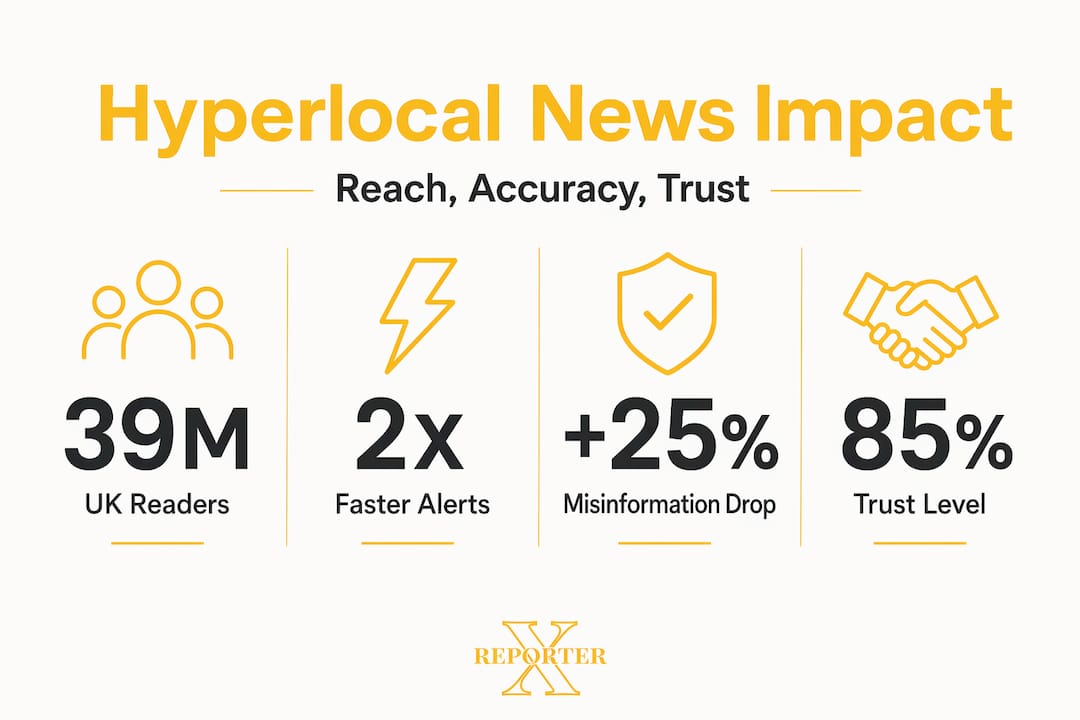
Hyperlocal outlets also serve a direct public safety function. A targeted government campaign using local press in flood-risk areas produced a 7% increase in residents signing up for flood alerts, a result that broader national media could not replicate because the message lacked geographic precision.
For local businesses, the connection is equally direct. When a hyperlocal outlet reports on a road closure near a commercial district, nearby businesses can communicate with customers, adjust delivery schedules, and manage their operations. That kind of specific, timely reporting supports local economic activity in ways that city-wide coverage rarely delivers.
The importance of hyperlocal news also shows up in misinformation prevention. Communities with active hyperlocal outlets have verified sources to consult when rumors spread on social media. Without that anchor, unverified claims about local institutions gain traction faster.

Formats and delivery methods
Modern hyperlocal news coverage rarely arrives through a printed newspaper. The formats have shifted significantly, though the editorial mission has not.
- Dedicated hyperlocal websites remain the dominant format, offering searchable archives, comment sections, and location-specific newsletters delivered directly to residents.
- Mobile apps with push notifications allow hyperlocal outlets to alert readers the moment a relevant story breaks. Technology enabling real-time news delivery has made this model far more effective than static print distribution.
- Community radio and podcasts serve residents who prefer audio formats. Platforms like Riply now power local radio with hyperlocal content reviewed by human editors, combining automation with editorial oversight.
- Social media groups and pages function as informal hyperlocal news channels, particularly in neighborhoods where formal outlets do not yet exist.
- Email newsletters remain highly effective for hyperlocal distribution because they reach subscribers who have actively opted in, signaling high interest in community-specific content.
Digital consumption of local news is growing. Over 39 million UK adults accessed local news online in November 2025 alone, demonstrating strong demand even as the economic models for sustaining that coverage remain under pressure.
What differentiates hyperlocal media from traditional newspapers is immediacy and accessibility. A neighborhood outlet can publish within minutes of a council meeting ending. A monthly print publication cannot serve that function.
Sustainability and funding models
Funding a hyperlocal news outlet presents a specific challenge. The audience is small by definition, which limits advertising revenue potential. Yet the outlets that survive tend to share a common characteristic: readers perceive them as community assets, not media products.
| Funding model | How it works | Key advantage |
|---|---|---|
| Local advertising | Businesses pay for audience-specific placement | Directly tied to community economic activity |
| Subscriber support | Readers pay monthly or annual fees | Stable, recurring revenue independent of ad market |
| Civic partnerships | Organizations fund coverage with contractual editorial independence | Sustains reporting without compromising integrity |
| Foundation grants | Nonprofit funders support journalism as public service | No audience-size requirement for eligibility |
Covering Katy News, a Texas-based outlet, serves 145,000 monthly readers funded entirely by local advertisers and subscribers. That model works because the publication is embedded in its community rather than operating as a remote branch of a larger media company.
Civic partnerships offer another path, but they require strict transparency. El Tímpano, a community-focused outlet serving Latino residents in the San Francisco Bay Area, uses contractual language that explicitly prevents funding sources from influencing editorial decisions. That kind of documented independence preserves reader trust, which is ultimately the most important asset any hyperlocal outlet holds.
Pro Tip: For communities looking at how to create hyperlocal news outlets, starting with a well-defined subscriber base before seeking advertisers tends to produce more editorial independence long-term.
My take on hyperlocal journalism's real value
I've covered the evolution of digital news long enough to have watched dozens of regional papers shrink their staffs and abandon bureau offices. What I've observed consistently is that the communities most affected are not the ones losing national wire coverage. They're the ones losing the reporter who attended every planning commission meeting, every school board session, every neighborhood association gathering.
In my view, the most underappreciated aspect of hyperlocal journalism is what I'd call the accountability proximity effect. When a reporter lives in the same neighborhood they cover, sources are not just contacts. They are neighbors. That relationship changes what gets reported and how quickly issues surface. Hyperlocal outlets act as first responders for local accountability precisely because of that proximity.
What I've found genuinely concerning is the assumption that social media fills the gap when local outlets close. It doesn't. Social media amplifies the loudest voices. Hyperlocal journalism amplifies the most relevant facts. Those are very different functions. Communities that treat hyperlocal news as optional infrastructure tend to discover its value only after losing it.
The future I see for this sector involves more civic partnership models and more reader-funded outlets. Both require communities to make a deliberate choice to support the journalism that serves them most directly.
— Trevor
Stay informed with Thexreporter
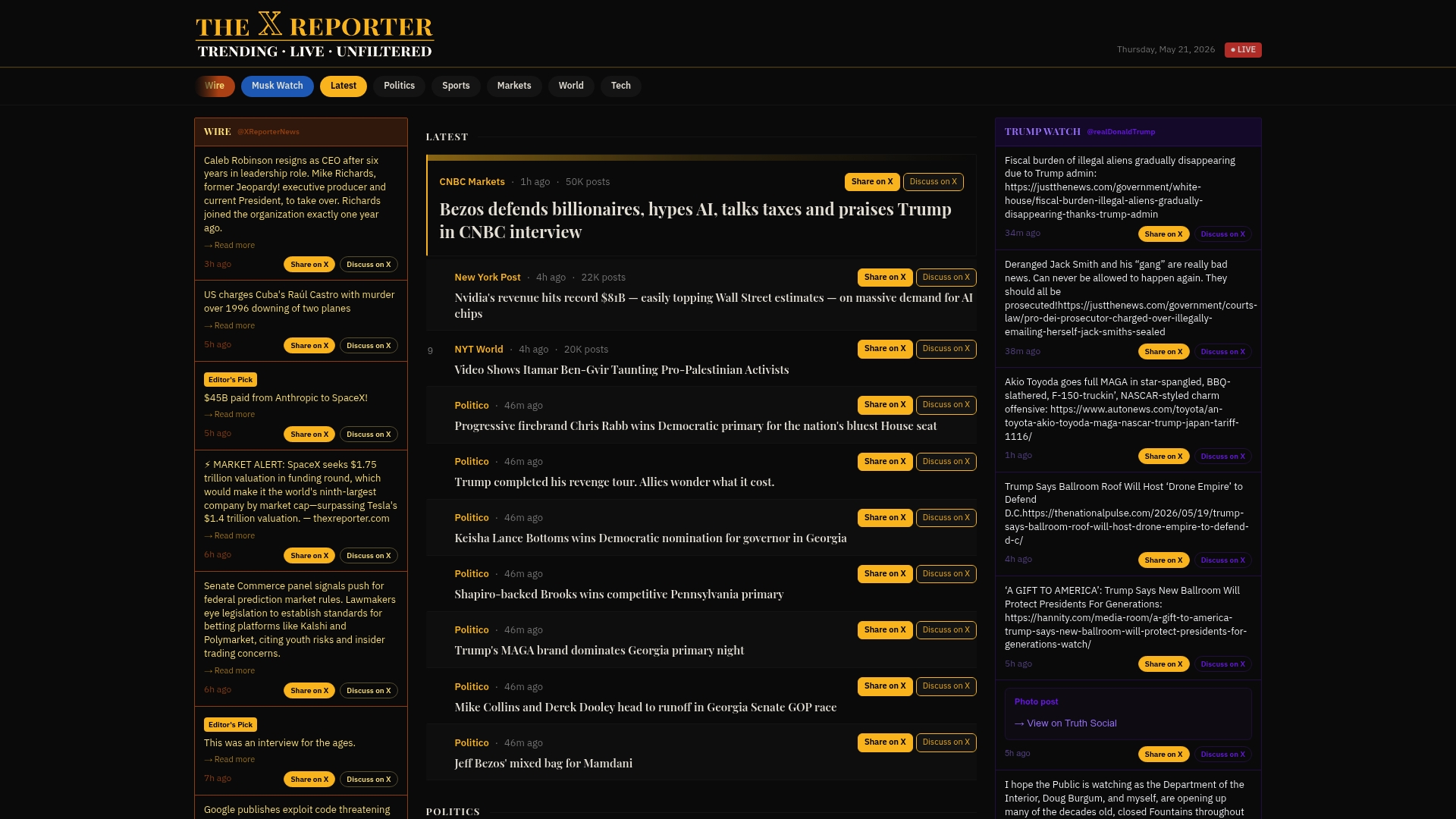
Thexreporter aggregates the stories that matter most, from neighborhood-level developments to national policy shifts, and distills them into clear, concise editorial summaries. For readers who want to track community news developments without spending hours across fragmented sources, the platform delivers precisely curated context alongside the facts. Whether you are monitoring local governance, following regional business trends, or tracking broader market movements, Thexreporter provides the analytical clarity that helps you act on information rather than just consume it. Explore the platform and see how structured, editorially reviewed news aggregation changes how efficiently you stay informed.
FAQ
What is the difference between local and hyperlocal news?
Local news covers a city or county, while hyperlocal news targets a single neighborhood, street, or defined community. The geographic specificity determines the editorial focus and the relevance to individual readers.
What are hyperlocal news examples?
Common examples include coverage of a neighborhood zoning hearing, a specific school's budget decision, a local business closure, or a community safety issue on a particular street. These are stories that affect a small, defined group of residents directly.
Why is hyperlocal news important for democracy?
Hyperlocal journalism holds local institutions accountable by monitoring councils, school boards, and public services that regional media frequently overlooks. Research links the loss of local news coverage to weaker civic engagement and reduced public service performance.
What are hyperlocal media formats?
Hyperlocal media includes dedicated websites, email newsletters, mobile apps, community radio, and podcasts. Digital formats have largely replaced print, with mobile push notifications enabling real-time delivery of community-specific stories.
How do hyperlocal news outlets stay funded?
Most outlets rely on a mix of local advertising, reader subscriptions, civic partnerships, and foundation grants. Outlets like Covering Katy News demonstrate that a local advertiser and subscriber model can sustain significant readership when community trust is strong.