

News story verification is the systematic process by which journalists and fact-checkers confirm the accuracy of claims before publication, using source triangulation, documentary evidence, and digital tools. The practice, formally called source verification or fact-checking in journalism, sits at the core of credible reporting. Tools like Google Fact Check Explorer, Snopes, and InVID have made the news story verification process more accessible to both professionals and everyday readers. Understanding how news stories are verified protects you from misinformation and builds the critical reading skills that quality journalism depends on.
How are news stories verified by journalists?
Journalists follow a structured, sequential process to verify news stories. The method begins by decomposing each claim into testable components: who made the claim, what exactly is being asserted, when and where the event occurred, and why the source has standing to report it. Breaking claims into testable parts allows reporters to isolate specific facts that can be confirmed or refuted independently, rather than accepting a story as a whole.
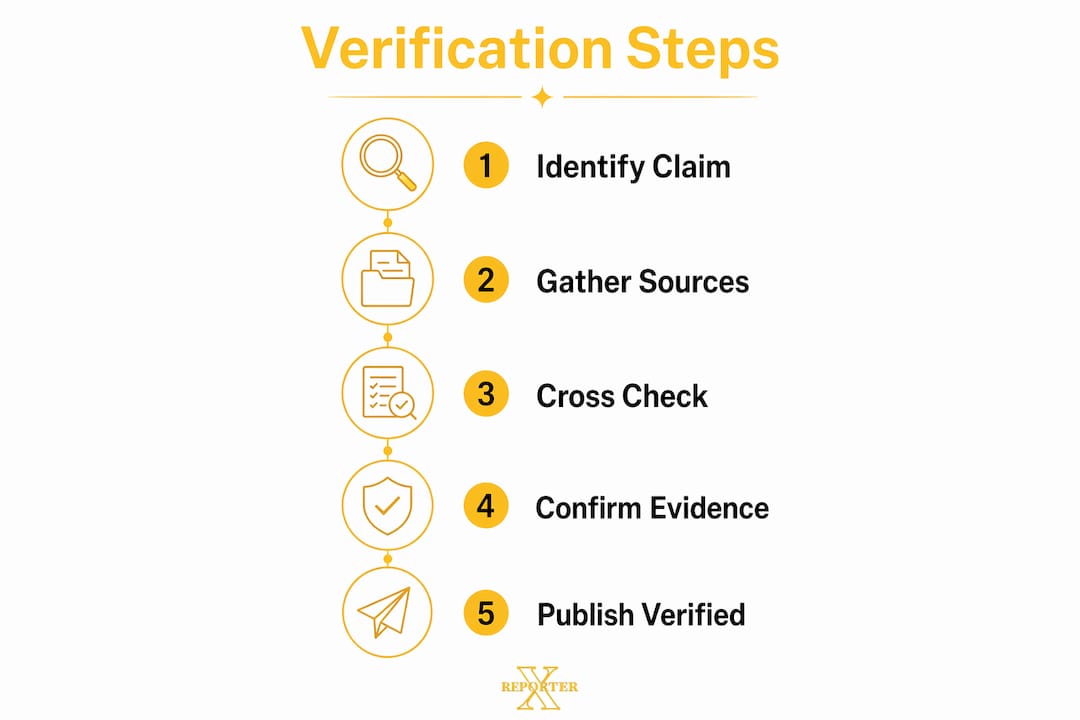
The steps in news verification typically follow this sequence:
- Identify the original source. Trace the claim back to its first point of publication or utterance. Secondary and tertiary reports often introduce errors through paraphrasing.
- Assess source credibility and motivation. Ask whether the source has direct knowledge, a potential conflict of interest, or a history of accuracy. Peer-reviewed studies carry more weight than press releases or survey data from special interest groups.
- Gather documentary evidence. Official records, court filings, government data, and primary documents provide reproducible proof that does not depend on a single person's account.
- Cross-check with independent sources. The two-source rule requires triangulating across different source types to avoid shared bias or a flawed original document. Two sources citing the same press release do not constitute independent corroboration.
- Apply direct observation where possible. Reporters who can physically confirm a location, event, or document add a layer of verification that no secondary source can replicate.
Professional fact-checkers go one step further. They actively try to prove claims false, searching for the strongest alternative explanation before accepting a story as accurate. This adversarial mindset is what separates rigorous verification from simple confirmation bias.
Pro Tip: When verifying a breaking story, assign separate team members to check documents, social media metadata, and human sources simultaneously. Parallel verification workflows are standard in professional newsrooms and prevent one lane of evidence from contaminating another.

What digital tools support the verification process?
Digital resources have expanded the methods for verifying news significantly, though no single tool is sufficient on its own. The most widely used platforms include:
- Google Fact Check Explorer: This aggregator has compiled more than 150,000 verified claims as of March 2026, making it the largest publicly accessible fact-check database available to consumers and journalists alike.
- Snopes: One of the oldest fact-checking sites on the internet, Snopes specializes in viral claims, urban legends, and political misinformation with detailed sourcing for each verdict.
- InVID and WeVerify: These browser extensions allow journalists to inspect video metadata, identify upload dates, and detect whether footage has been reused from unrelated events.
- Reverse image search (Google Images, TinEye): Uploading a photo to either platform reveals where it first appeared online, exposing recycled or misattributed images that are frequently used to fabricate context.
- AI detection tools: Platforms like Hive Moderation and Illuminarty analyze images and text for signs of synthetic generation, though their accuracy rates vary and results require human judgment to interpret.
The critical limitation of all these tools is that they confirm or deny specific artifacts, not the broader truth of a story. A photograph can be authentic while the caption describing it is false. A source can be real while their account is incomplete.
Pro Tip: Combine reverse image search with metadata inspection. An image may pass a visual search but still carry embedded EXIF data showing a different date or location than the story claims. Free tools like Jeffrey's Exif Viewer extract this data in seconds.
What are common challenges in news verification?
Several structural problems make the news story verification process harder than it appears. Recognizing these pitfalls is as important as knowing the correct steps.
- Citation illusion: Links that point to unrelated or broken sources create the appearance of evidence without providing it. Many readers assume a hyperlink confirms a claim without clicking through to verify the destination.
- Anonymous sourcing: Sources who cannot be named require additional corroboration. A single anonymous tip, even from a credible contact, does not meet the standard for publication without supporting documentation.
- Recycled and manipulated media: Misinformation campaigns routinely reuse old photographs, video clips, and statistics from unrelated events. The 2023 earthquake footage that circulated during multiple subsequent disasters is a documented example of this pattern.
- Source bias and access restrictions: Government data, corporate reports, and institutional studies can all reflect the interests of the entity that produced them. Verification requires identifying who funded a study and what incentives shaped its conclusions.
- Incomplete data presented as complete: A statistic drawn from a narrow sample is not necessarily false, but presenting it without context misleads readers about its applicability.
"Verification is not about proving a story true. It is about exhausting every reasonable path to proving it false before you publish." This principle, widely attributed to experienced investigative editors, reflects the standard that distinguishes credible newsrooms from those that prioritize speed over accuracy.
Transparency in editorial corrections also matters. Newsrooms that publish correction policies and issue timely corrections when errors are found demonstrate the kind of accountability that builds long-term reader trust.
How can you apply verification techniques in daily practice?
Both journalists and news consumers can integrate structured verification into their daily reading habits. The following sequence applies regardless of professional background:
- Pause before sharing or acting on a story. Cornell University's library science experts recommend the pause-reflect-investigate method as the primary defense against emotionally driven misinformation. Viral content is frequently designed to provoke an immediate reaction that bypasses critical thinking.
- Identify the original source. Ask where the story first appeared and whether the outlet has a track record of accuracy. Aggregators and social media posts rarely constitute primary sources.
- Practice lateral reading. Open multiple browser tabs and search for what other credible outlets say about the same claim. Lateral reading, a technique developed by the Stanford History Education Group, is faster and more reliable than reading a single article deeply.
- Question the chain of information. Each time a story is reprinted or summarized, details can shift. Trace the claim back to the original document, statement, or event.
- Apply the two-source standard to your own reading. If only one outlet is reporting a significant claim, treat it as unconfirmed until independent corroboration appears.
For journalists, the daily verification checklist approach formalizes these steps into a repeatable workflow that holds up under deadline pressure. Correction transparency, clear attribution of confidence levels, and editorial review before publication remain the professional standards that separate verified reporting from speculation.
Key takeaways
Rigorous news verification requires breaking claims into testable parts, triangulating across independent source types, and applying digital tools alongside human judgment to confirm accuracy before publication.
| Point | Details |
|---|---|
| Decompose every claim | Break stories into who, what, when, where, and why before assessing any evidence. |
| Triangulate source types | Two sources citing the same document do not constitute independent verification. |
| Use digital tools in combination | Google Fact Check Explorer, InVID, and reverse image search each cover different evidence types. |
| Watch for citation illusion | Always click through hyperlinks to confirm they support the claim being made. |
| Pause before engaging | Emotional triggers are a primary misinformation tool; pausing disrupts automatic sharing behavior. |
Why verification discipline matters more than ever in 2026
The volume of synthetic media and algorithmically amplified misinformation has made verification harder, not easier, despite better tools. What I have observed across years of editorial work is that the biggest failures in newsrooms rarely come from a lack of tools. They come from deadline pressure overriding the discipline to use them.
The two-source rule is taught in every journalism school, yet it gets quietly abandoned when a story is moving fast and a single credible contact has confirmed the headline. The result is corrections, retractions, and eroded reader trust that takes years to rebuild. The psychology behind viral news shows that emotionally charged stories spread fastest, which means the stories most likely to be wrong are also the ones most likely to reach millions before anyone checks them.
My view is that verification confidence levels should be published alongside stories, not just the conclusions. Readers deserve to know whether a claim rests on three independent primary sources or on one anonymous contact and a social media post. That transparency is not a sign of weakness. It is the standard that credible journalism should hold itself to in 2026.
— Trevor
Stay informed with verified news from Thexreporter
Thexreporter applies editorial verification standards to every story it surfaces, giving you concise, sourced summaries across politics, technology, and markets without the noise.
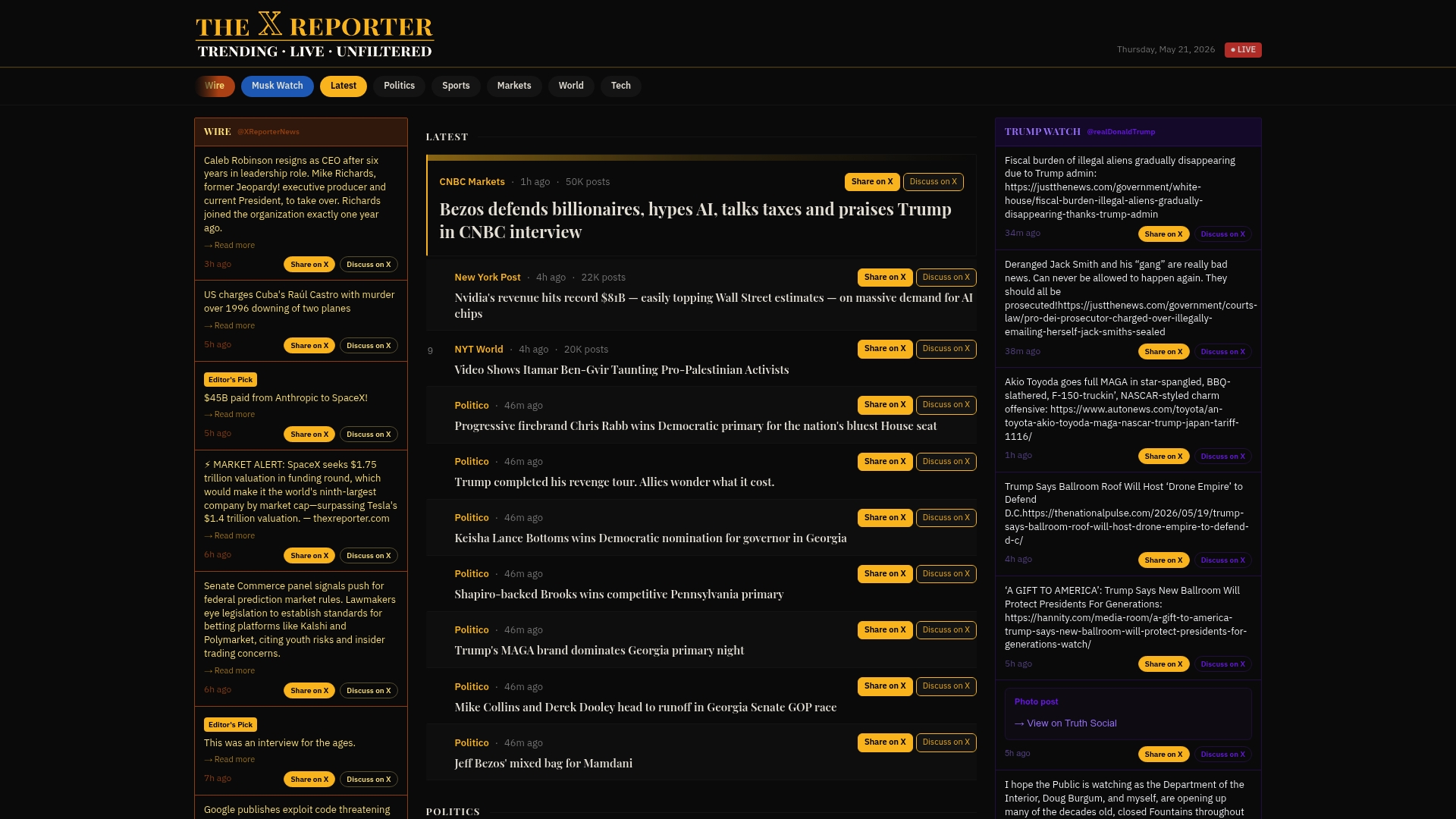
Whether you are a journalist refining your workflow or a reader who wants to understand how breaking news works before it reaches your feed, Thexreporter provides the context that raw aggregation misses. The platform distills verified reporting into formats that respect your time and your need for accuracy. Visit Thexreporter to explore curated news briefings built on the same verification principles this article outlines.
FAQ
What does it mean for a news story to be verified?
A verified news story has had its core claims confirmed through multiple independent sources, documentary evidence, and direct observation where possible. Verification means the story has withstood active attempts to disprove it, not just passive acceptance.
What tools do journalists use to verify news?
Journalists use Google Fact Check Explorer, Snopes, InVID, reverse image search tools like TinEye, and metadata inspection tools to verify specific claims and media assets. No single tool covers all evidence types, so professional verification combines several in sequence.
What is the two-source rule in journalism?
The two-source rule requires that significant claims be confirmed by at least two independent sources. Critically, those sources must be of different types to avoid shared bias, meaning two reporters citing the same press release does not satisfy the standard.
How can news consumers verify stories themselves?
News consumers can apply the pause-reflect-investigate method recommended by Cornell University, trace claims back to original sources, and use lateral reading across multiple credible outlets to confirm whether a story holds up before sharing it.
What is citation illusion and why does it matter?
Citation illusion occurs when hyperlinks in an article point to unrelated, broken, or unsupportive sources, creating a false impression of evidence. Clicking through every link to confirm it substantiates the claim it is attached to is a necessary step in any verification process.