

Most people have heard the phrase "news flash" in two very different contexts. One is the sarcastic version: "News flash — water is wet." The other is the real journalistic term, and understanding what is a news flash in its formal sense matters more now than ever. News flashes are a precise tool in broadcast journalism, designed to deliver urgent information before full details are confirmed. This article breaks down the news flash definition, traces its evolution across media formats, compares it to related terms, and explains why it still plays a critical role in today's information environment.
Table of Contents
- Key Takeaways
- What is a news flash and why it matters in journalism
- How technology changed the news flash format
- News flash vs. breaking news and other urgent formats
- Practical significance for audiences today
- My take on the news flash in today's media environment
- Stay ahead with Thexreporter
- FAQ
Key Takeaways
| Point | Details |
|---|---|
| Formal news flash definition | A news flash is a brief, urgent broadcast interrupting regular programming to report critical breaking events. |
| Distinct from breaking news | News flashes are shorter and more abrupt than breaking news segments, which allow for extended live coverage. |
| Speed vs. accuracy tension | Initial news flashes often carry incomplete facts, requiring audiences to follow up for full context. |
| Inverted pyramid structure | News flashes lead with the most critical facts first, following a structured journalistic writing style. |
| Colloquial vs. journalistic use | The phrase carries two meanings: a formal broadcast tool and a casual, often sarcastic, conversational expression. |
What is a news flash and why it matters in journalism
A news flash is precisely what its name suggests: a sudden, brief burst of urgent information delivered to the public as quickly as possible. Cambridge and Oxford dictionaries define it as a short, urgent item of important news that interrupts regular radio or television programming. The operative word here is interrupts. A news flash does not wait for the scheduled evening broadcast. It breaks through whatever is currently airing because the information is deemed too time-sensitive to hold.
The news flash definition centers on three core characteristics: brevity, urgency, and immediate public relevance. It is not a full story. It does not include background history or expert analysis. It delivers the essential facts, typically the who, what, when, and where, with the expectation that fuller reporting will follow. Journalistic standards reinforce this structure by emphasizing immediate details first and leaving causal explanations for feature reports.
The types of events that trigger news flashes include:
- Major natural disasters such as earthquakes or hurricanes making landfall
- Assassinations or sudden deaths of prominent political figures
- Large-scale terrorist attacks or acts of war
- Significant market crashes or financial system disruptions
- Emergency public health declarations
Pro Tip: When you encounter a news flash, treat it as the opening sentence of a much longer story. The most critical facts are present, but the full picture requires follow-up reporting from credible sources.
How technology changed the news flash format
The traditional news flash was a product of a simpler broadcast era. A news anchor would abruptly appear on screen, announce an urgent development in one or two sentences, and programming would resume. That format was the standard for most of the 20th century.
Several technological shifts fundamentally altered this model:
- Live satellite feeds allowed television networks to broadcast directly from the scene of major events in real time, reducing the need for brief interruption announcements.
- 24-hour cable news networks created a continuous reporting environment where news no longer needed to interrupt programming because the programming was the news.
- Internet news platforms made it possible to publish urgent stories within seconds of an event, bypassing broadcast schedules entirely.
- Mobile push notifications gave news organizations the ability to reach audiences directly on personal devices with single-sentence alerts that function much like traditional news flashes.
- Social media platforms accelerated the spread of urgent news, often before news organizations had confirmed the facts.
The result is that breaking news has largely replaced the traditional news flash in modern media. Rather than a brief interruption, audiences now receive continuous live coverage with rolling updates. Modern digital journalism also favors continuous live-blogging over rigid single-instance announcements.
This shift created a new problem. Speed increased, but so did the risk of error. Reporters face significant uncertainty when covering urgent events live with limited confirmed information, which can lead to early reports containing inaccurate details that require correction.

News flash vs. breaking news and other urgent formats
Understanding the news flash definition requires clarity on how it compares to related terms. These formats are sometimes used interchangeably in casual conversation, but in formal journalism, they serve distinct functions.
| Format | Length | Broadcast style | Level of detail | Typical trigger |
|---|---|---|---|---|
| News flash | 1 to 3 sentences | Abrupt program interruption | Minimal, core facts only | Single, high-impact event |
| Breaking news | Variable, often extended | Continuous live coverage | Expanding, updated in real time | Developing or ongoing situation |
| News bulletin | Short segment | Scheduled brief update | More structured than a flash | Periodic summary of top stories |
| Special report | Long-form | Extended broadcast interruption | In-depth analysis included | Major national or global events |
Urgent news formats differ primarily in their timing, duration, and depth of coverage. A news flash is the most stripped-down version of urgent communication. Breaking news expands on the initial alert and may continue for hours. A special report represents the most formal and extended interruption, typically reserved for events of historic significance such as a presidential address or a major geopolitical development.
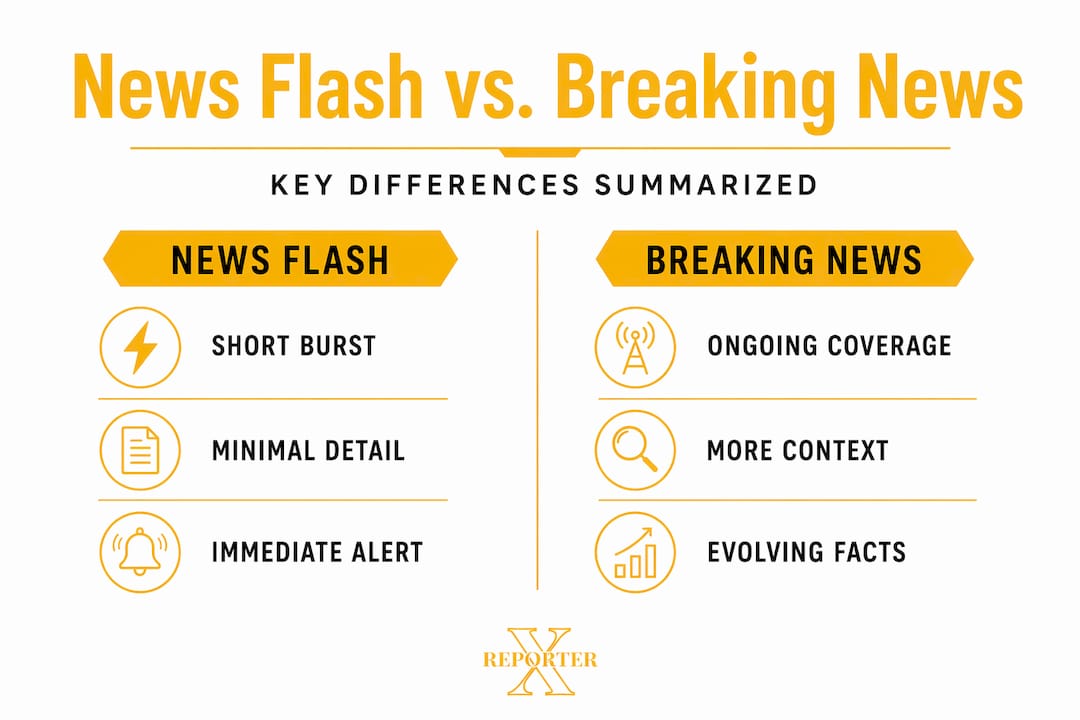
In practice, broadcast journalists often use these terms loosely. The phrase "news flash" has become less common in on-air language precisely because continuous coverage has made the concept of a brief interruption feel outdated.
Practical significance for audiences today
The importance of news flashes, and their modern equivalents, extends beyond the newsroom. Audiences depend on urgent news formats for time-critical information. During a natural disaster, a news flash or push notification may be the difference between evacuating in time and not.
The significance of these formats includes:
- Providing immediate public safety information during emergencies
- Signaling to audiences that normal information flow requires attention
- Setting the agenda for public discourse around major events
- Driving search behavior and follow-up consumption of detailed reporting
The risks are equally real. News flashes can cause confusion when initial facts are incomplete or rapidly evolving. Ethical reporting standards guide journalists in issuing these alerts responsibly, balancing the duty to inform quickly against the obligation to report accurately.
Understanding how news spreads virally also helps audiences recognize why early reports sometimes conflict with later verified accounts. The first version of a news flash is rarely the final word on any event.
Pro Tip: After receiving a news flash or breaking news alert, wait for at least two independent confirmations from established news organizations before drawing firm conclusions about the details.
My take on the news flash in today's media environment
I have watched the news flash evolve from a near-sacred broadcast ritual into something approaching an afterthought. In my experience, what we lost when continuous coverage replaced the traditional news flash was a kind of enforced editorial discipline. When you have 30 seconds to tell the public something critical, you cannot afford imprecision.
What concerns me more is the colloquial drift of the term itself. When "news flash" is primarily understood as a sarcastic expression, its journalistic weight erodes. People stop associating it with genuine urgency.
My honest assessment: the format itself is not obsolete. The push notification is the spiritual successor to the news flash, and it carries enormous power. The problem is that this power is not always used responsibly. Not every notification warrants the same level of urgency that a traditional news flash implied.
I would encourage readers to engage with urgent news critically. Ask who confirmed it, when it was confirmed, and what remains unverified. That discipline protects you from the confusion that incomplete early reports routinely generate.
— Trevor
Stay ahead with Thexreporter
If you want to apply what you have learned about urgent news formats in real time, Thexreporter is built for exactly that purpose.
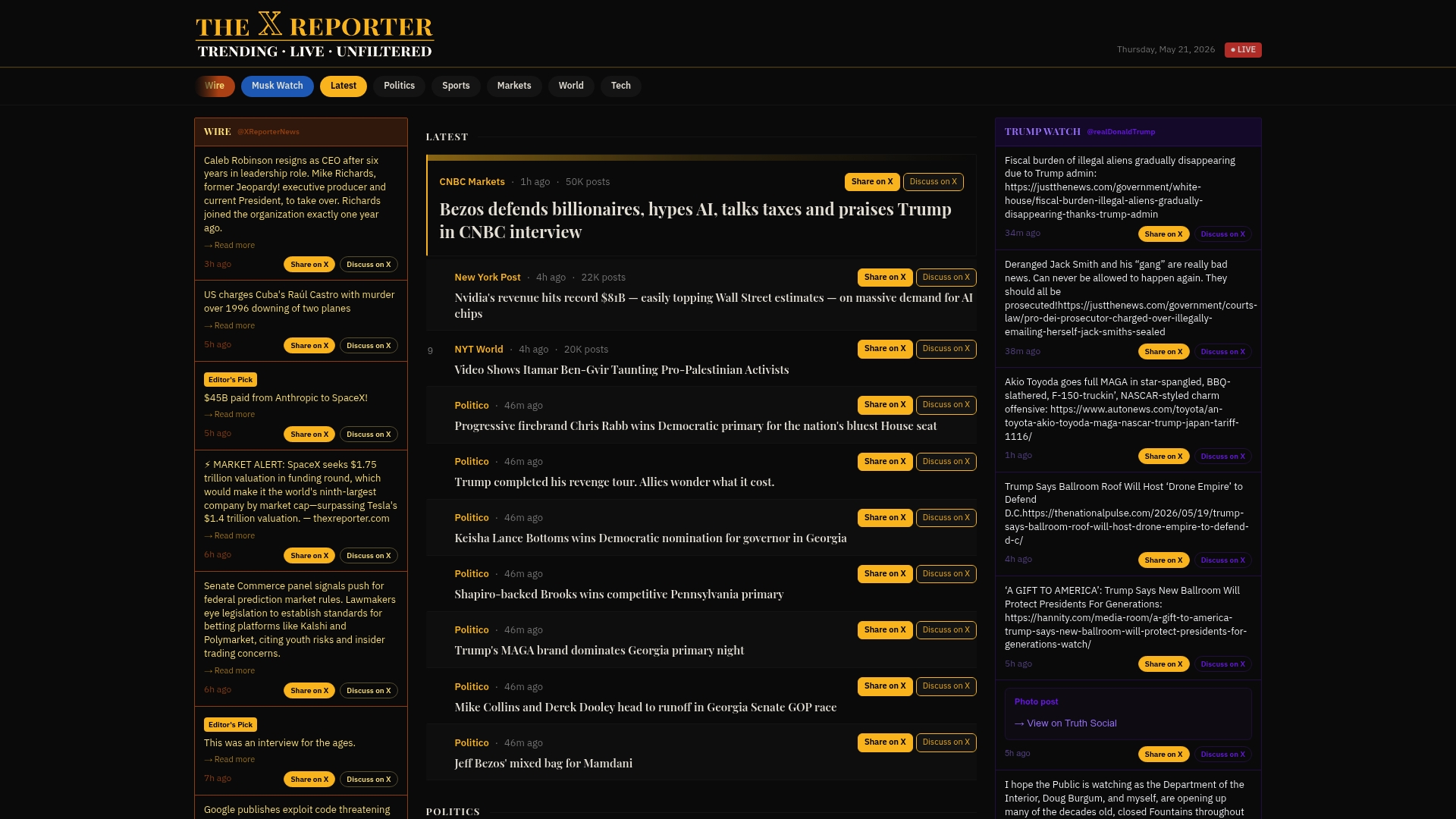
Thexreporter aggregates live, unfiltered news across politics, technology, and markets, delivering concise editorial summaries that give you context, not just raw alerts. Rather than sifting through dozens of sources when a major story breaks, you get the most relevant developments distilled into a format that respects your time. For anyone who wants to understand not just what is happening but why it matters, Thexreporter provides the analytical layer that news flashes and breaking alerts rarely offer on their own.
FAQ
What is the formal definition of a news flash?
A news flash is a brief, urgent item of news that interrupts regular radio or television programming to report a significant event. It focuses on core facts, typically covering who, what, when, and where, without detailed analysis.
What does news flash mean in casual speech?
In casual speech, "news flash" is often used sarcastically to introduce information the speaker considers obvious or unsurprising. This colloquial use differs significantly from its formal journalistic meaning.
What is the difference between news flash and breaking news?
A news flash is a very short, abrupt interruption delivering minimal facts about a single urgent event. Breaking news is a broader format that allows for extended, continuously updated live coverage of a developing situation.
How should audiences interpret a news flash?
Audiences should treat a news flash as an initial alert requiring follow-up. Early reports frequently contain incomplete or unverified details, so waiting for confirmed reporting from multiple established sources before drawing conclusions is advisable.
Is the news flash still used in modern journalism?
Traditional news flash interruptions are less common today due to 24-hour news cycles and continuous live coverage. However, mobile push notifications and digital alerts serve an equivalent function, delivering urgent, brief updates directly to audiences.