

A news lead, also called a "lede," is the introductory paragraph of a news story that summarizes the main point and draws readers into the full report. Every newspaper article, online news post, and broadcast script depends on a strong lead to deliver the most critical facts before the reader decides whether to continue. Merriam-Webster defines the lede as the section designed to entice readers while covering the five Ws and an H. Mastering the news lead definition is the single most practical skill any aspiring journalist can develop, because without it, even a well-reported story loses its audience in the first sentence.
What is a news lead and why does it matter?
A news lead is the first paragraph of a news story, and without a lead, a news report is structurally incomplete. It serves two functions simultaneously: it informs and it retains. A reader who finishes the lead should know the core of the story. A reader who stops at the lead should still walk away with the most important fact.
The importance of news leads extends beyond reader experience. Editors routinely cut stories from the bottom up when space is tight. A well-constructed lead protects the story's core information regardless of how much gets trimmed. This is why journalism schools from Columbia to Northwestern treat lead writing as a foundational discipline, not an advanced technique.
Leads also shape how audiences perceive credibility. A vague or delayed opening signals weak reporting. A precise, factual opening signals authority. For aspiring journalists, the lead is the first test of news judgment every single time.

What information belongs in a traditional news lead?
A hard news lead delivers the five Ws and an H in the first paragraph to give readers an immediate, complete snapshot of the story. Each element carries specific weight.
- Who identifies the person or organization at the center of the story. "The Federal Reserve" or "President Biden" tells readers exactly whose actions matter.
- What states the event or development. "raised interest rates by 0.25 percentage points" is precise. "did something with rates" is not.
- When anchors the story in time. "Tuesday" or "on March 4" prevents confusion and establishes newsworthiness.
- Where provides geographic context. "in Washington, D.C." or "at the United Nations headquarters in New York" grounds the story.
- Why explains the cause or motivation. This element is often the hardest to compress but the most valuable for reader understanding.
- How describes the mechanism or method. In breaking news, this element is sometimes omitted from the lead and addressed in the body.
Not every lead must answer all six questions. A strong lead answers the most newsworthy ones first and leaves secondary details for subsequent paragraphs. Journalism resources advise keeping leads to under 40 words or roughly 300 characters, which forces writers to prioritize ruthlessly.
Pro Tip: Write the lead last. Report the full story first, then identify the single most important fact. That fact belongs in sentence one.
What are the different types of news leads?
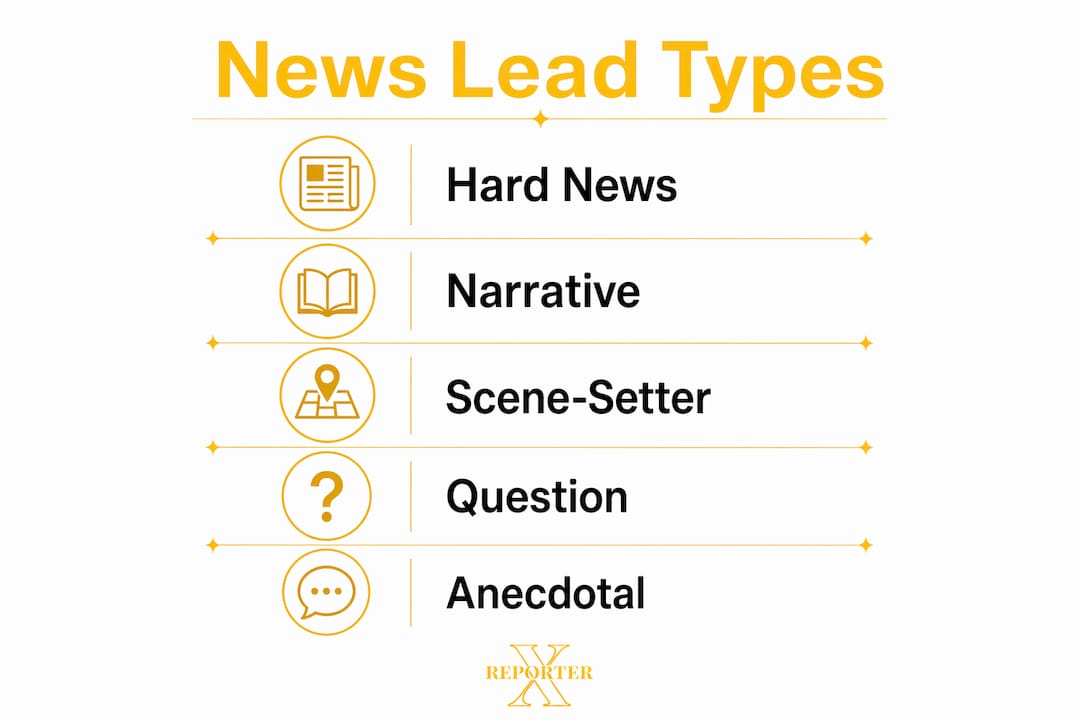
Different lead types exist to match different story contexts, and choosing the wrong type for a story is one of the most common errors student journalists make. The table below outlines the primary types and their appropriate uses.
| Lead type | Best used for | Key characteristic |
|---|---|---|
| Hard news (summary) lead | Breaking news, crime, politics, finance | Answers 5 Ws and H immediately |
| Narrative lead | Feature stories, profiles, long-form | Opens with a scene or character detail |
| Analysis lead | Policy, economics, investigative pieces | Assumes reader knowledge; explains significance |
| Blind lead | Stories where identity is withheld legally | Describes role or action without naming subject |
| Scene-setter lead | Human interest, enterprise journalism | Establishes atmosphere before the news point |
The hard news lead is the default format taught in most journalism programs, and for good reason. It transfers maximum information in minimum space. The Associated Press Stylebook and Reuters Handbook both treat the summary lead as the standard for straight news reporting.
Narrative and scene-setter leads require a follow-up paragraph called the nut graf. The nut graf answers the "So what?" question that the soft lead deliberately delays. Without a nut graf, a narrative lead leaves readers wondering why the story matters. The nut graf typically appears in the second or third paragraph and states the story's significance directly.
Pro Tip: If you write a narrative or scene-setter lead, place the nut graf no later than the fourth paragraph. Readers will not wait longer than that for the point.
How to write an effective news lead
Writing a strong lead requires selecting the single most prominent news element and placing it first. Choosing the right angle determines whether the lead reads as authoritative or buried. Follow this process:
- Identify the most newsworthy fact. Ask yourself: what would a colleague say if you described this story in one sentence at lunch? That sentence is your lead.
- Write a draft lead of no more than 35 words. Count the words. If you exceed 35, cut the least critical detail.
- Check for passive voice. "The bill was signed by the governor" is weaker than "The governor signed the bill." Active constructions read faster and feel more authoritative.
- Verify all six elements are addressed or deliberately omitted. If you omit "why," confirm it belongs in paragraph two, not missing entirely.
- Read the lead aloud. If you stumble, the sentence is too complex. Restructure it.
The most common pitfall in lead writing is burying the lead. This happens when a writer places context, background, or scene-setting before the actual news. "For the past decade, city officials have debated infrastructure funding" is context. "The city council approved a $2 billion infrastructure package on Wednesday" is the lead. The second sentence belongs first, always.
A second common error is confusing the lead with the nut graf. The lead states the news. The nut graf explains why it matters. Combining both functions into one sentence produces an overloaded, unreadable opening.
Pro Tip: After drafting your lead, ask: "Could an editor cut every paragraph after this one and still publish a coherent story?" If yes, your lead is working.
News lead examples that demonstrate the principles
Examining real-world examples clarifies what separates a functional lead from a strong one. The following examples illustrate different lead types in practice.
- Hard news lead: "The Federal Reserve raised its benchmark interest rate by a quarter point Wednesday, citing persistent inflation above its 2% target." This lead answers who (Federal Reserve), what (rate increase), when (Wednesday), and why (inflation) in 22 words.
- Narrative lead: "Maria Gonzalez has not slept a full night since the factory closed in January." This lead opens with a human detail. It requires a nut graf in the next paragraph to explain the broader story of manufacturing job losses.
- Analysis lead: "Three years of consecutive rate hikes have failed to bring U.S. inflation below 3%, raising questions about the limits of monetary policy." This lead assumes the reader knows what rate hikes are and focuses on significance rather than event.
- Blind lead: "A senior White House official resigned Thursday amid an ongoing ethics investigation." The subject is unnamed because the identity is legally sensitive at time of publication.
Each of these examples appears in types of news stories that journalists encounter across beats. Studying leads from The New York Times, Reuters, and The Washington Post across these categories builds pattern recognition faster than any textbook exercise.
For additional context on how leads function in fast-moving situations, the mechanics of a news flash format show how extreme brevity forces the lead to carry the entire story.
Key takeaways
A news lead is the most consequential sentence in any news story, and its quality determines whether readers stay or leave within the first five seconds.
| Point | Details |
|---|---|
| Core definition | A news lead is the opening paragraph that delivers the most important facts immediately. |
| The 5 Ws and H | Who, what, when, where, why, and how form the structural backbone of a hard news lead. |
| Lead length | Effective leads stay under 40 words to balance information density with readability. |
| Lead types | Hard news, narrative, analysis, blind, and scene-setter leads each serve different story contexts. |
| Nut graf distinction | Narrative leads require a nut graf by paragraph four to answer the "So what?" question. |
Why lead writing is harder than it looks
I have reviewed hundreds of first drafts from journalism students, and the same error appears in nearly every one. The writer knows the most important fact but saves it for paragraph three because they want to "set the scene" first. That instinct comes from essay writing, where context precedes argument. News writing reverses that structure entirely.
The shift to digital media has made this discipline more demanding, not less. Readers on mobile devices decide within two seconds whether a story is worth their time. A lead that delays the news by even one sentence loses a measurable share of that audience. Social media platforms like X (formerly Twitter) and LinkedIn surface the first line of linked articles in previews, which means the lead now functions as both an opening paragraph and a headline substitute.
The daily habits of working journalists reinforce lead discipline through repetition. The writers who improve fastest are those who rewrite their leads three or four times before filing, not those who treat the first draft as final. Experiment with lead types on the same story. Write the hard news version, then write the narrative version. Comparing the two builds judgment about which approach serves the story better.
— Trevor
Practice lead writing with Thexreporter
Thexreporter publishes trending live news across politics, markets, and technology, making it a practical resource for studying how professional leads are constructed in real time. Every story on the platform opens with a concise editorial summary that models the principles covered in this article.
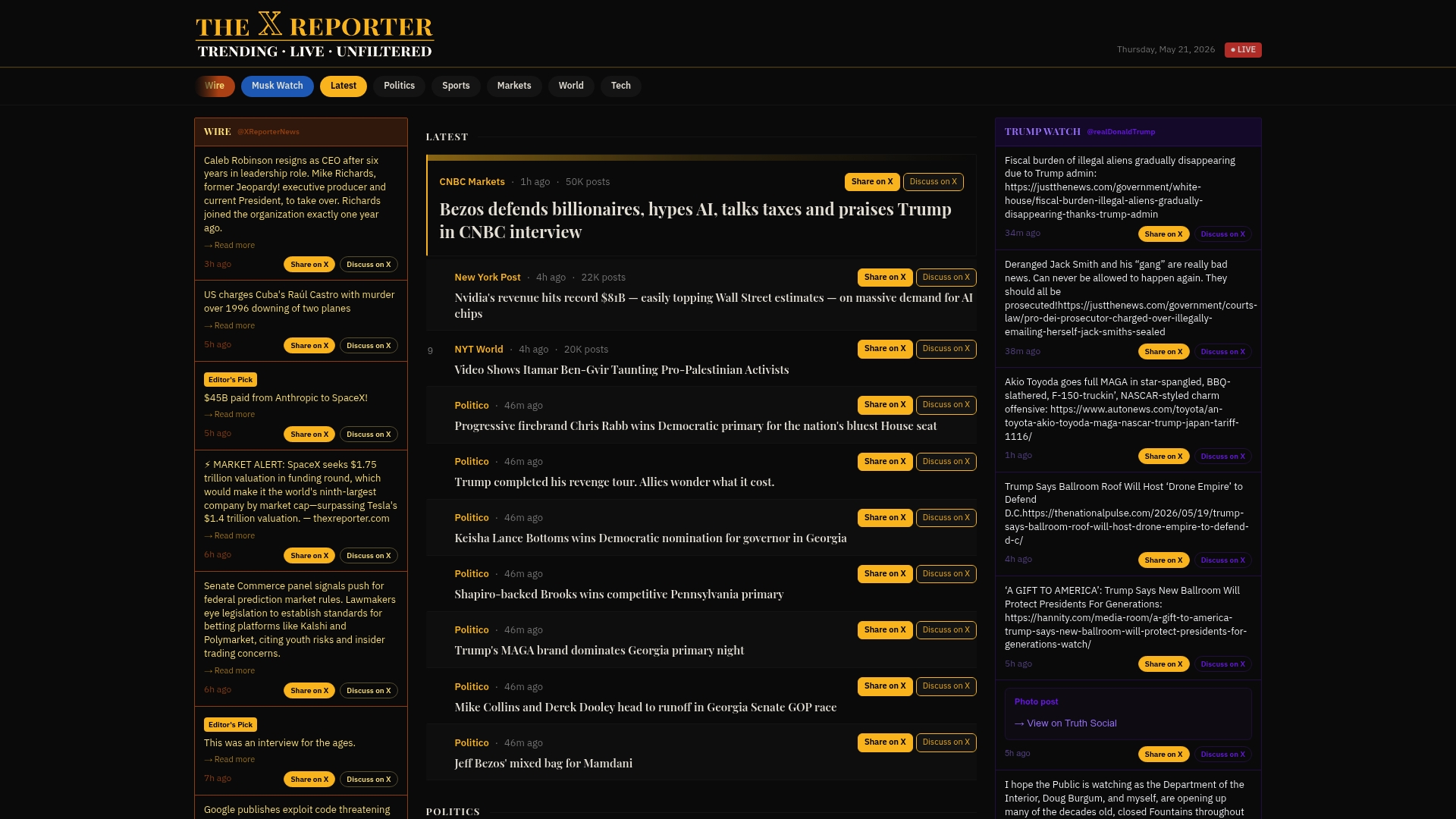
Aspiring journalists can use Thexreporter to compare lead styles across beats, observe how breaking news leads differ from analysis pieces, and track how leads evolve as stories develop. The platform's focus on distilling complex stories into clear, direct summaries reflects the same discipline that strong lead writing demands. Visit Thexreporter to read current stories and apply the techniques from this guide to real examples.
FAQ
What is the standard length for a news lead?
Effective leads stay under 40 words or approximately 300 characters. Most journalism style guides recommend 20 to 35 words as the target range for hard news leads.
What does "burying the lead" mean?
Burying the lead means placing the most important fact later in the story instead of in the first paragraph. It is one of the most common errors in news writing and causes readers to disengage before reaching the key information.
What is the difference between a lead and a nut graf?
A lead states the news. A nut graf follows soft or narrative leads to explain why the story matters. The two serve different functions and should not be combined into a single paragraph.
Do all news leads need to answer all five Ws and H?
Hard news leads aim to answer the 5 Ws and H in the first paragraph, but not every element must appear if it is not yet known or not newsworthy. The most critical elements take priority, and secondary details move to the body of the story.
Why is the lead spelled "lede" in journalism?
The spelling "lede" is a deliberate variation used in newsrooms to distinguish the opening paragraph from the typographic term "lead," which historically referred to the metal spacing used in printing. Both spellings refer to the same concept in modern journalism practice.