

Cross-platform news is defined as the deliberate distribution of journalism across multiple channels, including apps, social media, newsletters, streaming, and web, each formatted to match the native expectations of that platform. Audiences no longer consume news from a single source or device. Publications like Die Zeit and Sky News have restructured entire newsrooms around this reality, treating each story as a flexible asset rather than a finished product. The role of cross-platform news extends beyond reach. It shapes how audiences engage, how newsrooms operate, and how credibility is built or lost in a fragmented media environment.
How cross-platform news shapes audience engagement
The most direct evidence of cross-platform news impact comes from owned app channels. Lookout Local, a regional news publisher based in Eugene, Oregon, found that app users average 11 sessions per month versus 3 on the website. That is a 3.6 times engagement advantage. Engagement time on the app grew 153% over the same period. These numbers confirm that platform-native delivery does not just attract more clicks. It builds habitual consumption.
Audiences today move across devices and formats throughout the day. A reader might catch a headline via a push notification at 7 a.m., read the full story on a mobile app during a commute, and share a social clip that evening. Each touchpoint requires a different content format and presentation logic. News organizations that treat all platforms as identical lose readers at every transition.
The importance of cross-platform news also shows up in referral independence. Owned app channels reduce dependence on social and search referrals, which are subject to algorithm changes outside editorial control. Publishers who build direct audience relationships through apps and newsletters sustain engagement even when Facebook or Google adjusts its feed ranking.
- App users show significantly higher session frequency than web visitors
- Push notifications drive re-engagement at specific moments in the day
- Newsletters create predictable, scheduled touchpoints that build reading habits
- Social clips serve discovery, not depth, and should be designed accordingly
Pro Tip: Design your content workflow around platform behavior first. Ask how a reader on each channel actually consumes content before deciding on format, length, or headline style.
What operational shifts enable cross-platform production?

Traditional newsrooms produced a single article, then adapted it for other platforms afterward. That sequential model creates delays and inconsistencies. The shift to story-centric production replaces it with parallel platform-native outputs, where a single verified news object generates web copy, a social post, a push notification, and a newsletter excerpt simultaneously.

Sky News and Die Zeit both adopted versions of this model, restructuring editorial, product, and production teams to collaborate at the story conception stage rather than the distribution stage. INMA's 2026 World Congress documented this shift, noting that early team collaboration for multi-format packaging is now standard practice among leading publishers. The concept driving this is "liquid content," where journalistic knowledge is treated as a flexible core asset rather than a finished article.
API-driven automation handles much of the mechanical work. A structured content pipeline generates tailored outputs for each channel from one source, reducing manual rework and improving accuracy across formats. Finnish public broadcaster YLE uses a modular content approach, allowing the same reporting to move fluidly across formats and audience segments without requiring full rewrites.
The four operational changes most publishers make when adopting this model:
- Shift from article-first to story-object-first production
- Integrate editorial and product teams at the planning stage
- Implement API-driven publishing to automate channel-specific formatting
- Replace sequential repackaging with parallel, simultaneous platform outputs
| Legacy workflow | Story-centric workflow |
|---|---|
| Article written, then adapted | Story object created, all formats generated simultaneously |
| Siloed editorial and tech teams | Editorial, product, and production collaborate from the start |
| Manual reformatting per platform | API automation handles platform-specific outputs |
| Delayed cross-platform publishing | Real-time multi-channel distribution |
Pro Tip: Unified audience data across all platforms is the missing layer in most cross-platform strategies. Without it, engagement analysis stays fragmented and decisions stay reactive.
Does cross-platform delivery affect news credibility?
Credibility in cross-platform news is shaped by psychology and social dynamics, not content quality alone. A 2026 peer-reviewed study published in Entertainment Computing identified two key behavioral constructs that influence how audiences perceive news credibility across platforms: the "News-Finds-Me" perception and the social bandwagon effect.
The News-Finds-Me perception describes audiences who believe relevant news will reach them passively through social feeds and notifications, without active seeking. This group is more susceptible to sharing content based on social signals rather than editorial verification. The bandwagon effect amplifies this. When a story appears across multiple platforms simultaneously, audiences interpret widespread visibility as a signal of credibility, regardless of source quality.
"Cross-platform media credibility is not solely determined by the quality of content. Psychological and social factors, including perceived ubiquity and peer sharing behavior, significantly shape how audiences evaluate and act on news." Entertainment Computing, 2026
This has direct implications for how publishers design their distribution strategy. Appearing on multiple platforms builds perceived authority. But it also means that misinformation spreads faster when it mimics the visual and structural cues of credible cross-platform journalism. Understanding news virality psychology is now part of responsible editorial strategy, not just marketing.
- Passive news consumers rely on platform signals to judge credibility
- Multi-platform presence increases perceived authority of a news source
- Social sharing behavior is driven by visibility as much as content quality
- Publishers must design for trust signals, not just information delivery
Examples of cross-platform news delivery in practice
The benefits of cross-platform news become concrete when you examine how specific formats serve different audience needs. A breaking political story, for example, requires a different presentation on each channel. A daily news briefing checklist for journalists in 2026 reflects exactly this kind of platform-specific planning.
| Platform | Content format | Primary audience need |
|---|---|---|
| Mobile app | Push notification + full article | Speed and depth |
| Social media | Short video clip or graphic | Discovery and sharing |
| Newsletter | Curated summary with context | Habit and analysis |
| Streaming/podcast | Audio or video explainer | Commute consumption |
| Website | Long-form with related links | Research and reference |
API-driven workflows make this differentiation scalable. A single verified news object enters the pipeline and exits as five distinct formats, each optimized for its channel. AI tools handle transcription, summarization, and related content surfacing, reducing the manual burden on journalists while preserving editorial control over the core reporting.
Localization adds another layer. A national story about interest rate policy requires different framing for a regional newsletter audience than for a financial markets app. Cross-platform news strategies that include localization logic produce higher relevance scores and lower unsubscribe rates. Platform-native delivery through push notifications, for instance, performs best when the message is timed and worded to match the reader's context at that moment.
Key takeaways
Cross-platform news succeeds when stories are designed as flexible assets from the start, distributed through owned channels, and measured with unified audience data across every platform.
| Point | Details |
|---|---|
| App engagement advantage | App users engage 3.6 times more than web visitors, making owned channels a priority. |
| Story-centric production | Parallel platform outputs replace sequential repackaging, improving speed and consistency. |
| Credibility beyond content | Psychological factors like bandwagon effects shape audience trust across platforms. |
| API automation scales delivery | Structured pipelines generate platform-specific formats from a single news object. |
| Owned channels reduce risk | Direct audience relationships through apps and newsletters limit algorithm dependency. |
Why the future of cross-platform news depends on audience-first thinking
I have watched publishers spend significant resources on multi-platform distribution only to see engagement plateau. The pattern is consistent. The technology works. The workflows improve. But the results disappoint because the content itself was not designed with each platform's audience in mind. It was designed once and pushed everywhere.
The future of cross-platform news does not belong to publishers with the most channels. It belongs to those who understand that a reader on a podcast app during a morning run has a fundamentally different need than the same reader opening a newsletter at a desk. Sky News and YLE get this right not because of their technology stack, but because their editorial culture starts with the question: who is consuming this, where, and why?
The uncomfortable truth is that most organizations still measure cross-platform success by reach metrics. Pageviews, impressions, follower counts. These tell you how many people saw your content. They do not tell you whether your journalism built a habit, earned trust, or influenced understanding. Shifting to product-level metrics, session frequency, return visit rate, and time-per-session, reveals whether your cross-platform strategy is actually working or just distributing noise at scale.
Speed and trust are not in conflict in this model. They are both outputs of a well-designed story-centric workflow. When you build the right infrastructure, you publish faster and more accurately across every channel. That is the real case for investing in cross-platform journalism.
— Trevor
Stay ahead with Thexreporter
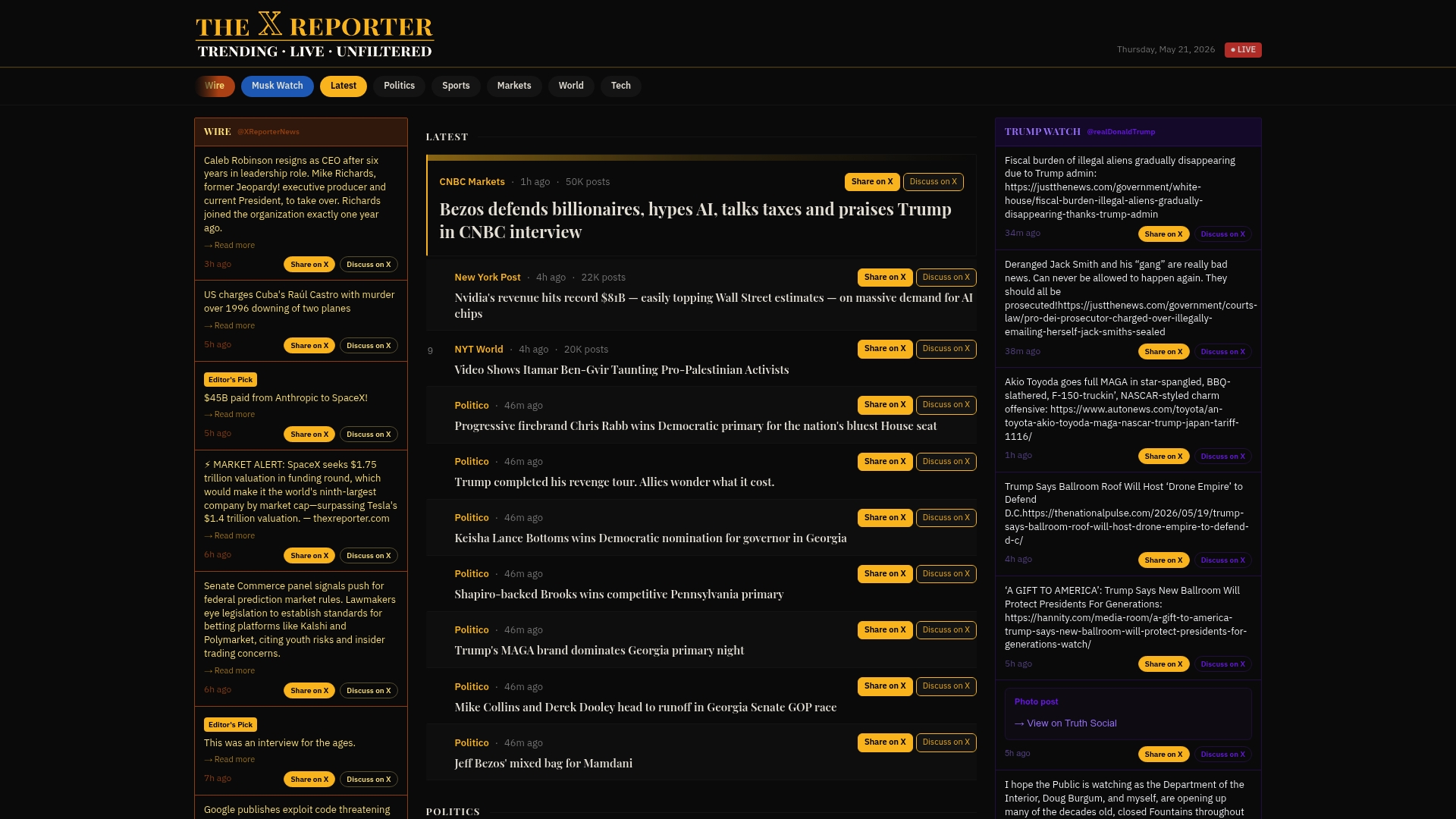
Thexreporter is built around the principles this article describes. It delivers trending, live, unfiltered news across politics, technology, and markets in concise editorial summaries designed for readers who need context without the noise. Every story on Thexreporter is curated to highlight the key takeaway first, reflecting the same audience-first logic that defines effective cross-platform journalism. If you want to experience what well-executed cross-platform news delivery looks like in practice, Thexreporter is the place to start. Explore the platform and see how social video formats and editorial curation combine to keep you informed across every format you use.
FAQ
What is the role of cross-platform news in modern journalism?
Cross-platform news distributes journalism across apps, social media, newsletters, and streaming, each formatted for that platform's audience. Its role is to maximize reach, build habitual engagement, and maintain editorial relevance across a fragmented media environment.
How does cross-platform news improve audience engagement?
Owned app channels produce significantly higher engagement than web alone. Lookout Local data shows app users average 11 sessions per month versus 3 on the website, with engagement time growing 153%.
What are the main challenges of cross-platform news production?
The primary challenges are maintaining unified audience data across platforms, avoiding fragmented analytics, and redesigning legacy siloed workflows into parallel, story-centric production models.
How does cross-platform delivery affect news credibility?
Research published in Entertainment Computing in 2026 shows that credibility is shaped by psychological factors like the News-Finds-Me perception and social bandwagon effects, not content quality alone.
What is liquid content in cross-platform journalism?
Liquid content treats journalistic knowledge as a flexible core asset rather than a finished article, allowing the same reporting to adapt across streaming, social, newsletters, and broadcast formats simultaneously.