

Following technology news developments is the practice of systematically tracking current updates, analyses, and emerging tech trends across multiple trusted sources to stay informed and ahead. Professionals who rely on a single feed or social platform miss critical context. The most reliable approach combines RSS readers like Inoreader or NetNewsWire, automated multi-source pipelines modeled on Reuters-style monitoring, and curated outlets such as BBC Technology. This article covers the tools, pipeline architecture, and analysis strategies that separate reactive news consumers from professionals who act on information before it becomes common knowledge.
What tools let you follow technology news developments effectively
RSS feeds remain the most reliable mechanism for receiving latest tech news updates without algorithmic interference. Unlike social platforms, RSS delivers content directly from the source on a predictable schedule. BBC Technology's feed at "feeds.bbci.co.uk/news/technology/rss.xml` merges articles, audio, and video into a single URL updated five to seven times weekly, covering a rolling 30-day content window. That single endpoint gives you text, BBC Sounds audio, and BBC iPlayer video in one pull.
The right reader determines how efficiently you process that volume. Three tools stand out for professionals:
- Inoreader handles high-volume feeds with folder organization, keyword alerts, and API access for automation workflows.
- Reeder (macOS and iOS) prioritizes reading speed and clean typography, ideal for daily digest habits.
- NetNewsWire is open-source, fast, and integrates with iCloud sync across Apple devices at no cost.
Beyond RSS, email alerts from Google Alerts and push notifications from apps like Feedly or Flipboard serve as secondary layers. They catch stories that fall outside your curated feed list. The table below compares the primary options:
| Tool | Type | Best for | Cost |
|---|---|---|---|
| Inoreader | RSS reader | Power users, automation | Free / paid tiers |
| NetNewsWire | RSS reader | Apple ecosystem, open-source | Free |
| Reeder | RSS reader | Clean reading experience | One-time purchase |
| Google Alerts | Email alerts | Keyword monitoring | Free |
| Feedly | Aggregator | Team collaboration | Free / paid tiers |

Pro Tip: Set up a dedicated folder in Inoreader for vendor-specific feeds (AWS, Google Cloud, Microsoft Azure) separate from journalism feeds. This separation lets you triage product changes from editorial analysis without mixing signal types.
How to build an automated multi-source technology news pipeline
A Reuters-style news pipeline ingests multiple sources, normalizes the data, scores relevance, and routes alerts to the right audience. This is the architecture used by professional newsrooms and intelligence teams. Replicating it for personal or organizational use is now practical with available open-source tools.
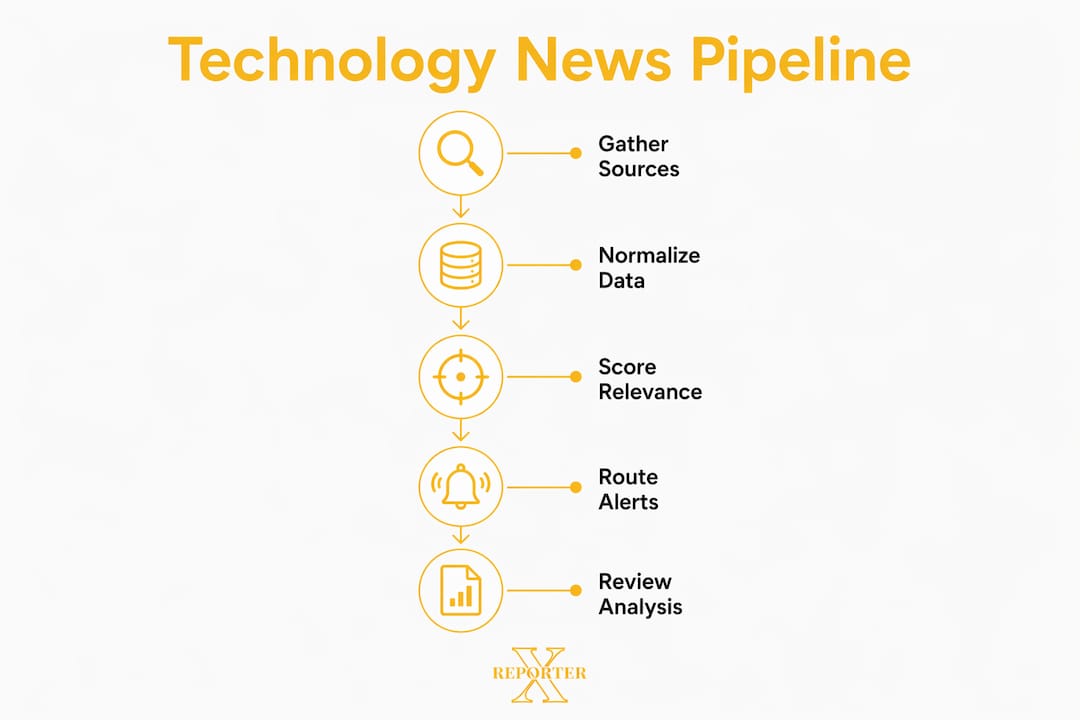
Multi-source coverage is the foundation. Vendor release notes alone miss broader market context. A complete source list includes vendor changelogs, regulatory agency feeds, security advisories (CISA, NVD), earnings call transcripts, and journalism from outlets like BBC Technology, Ars Technica, and The Verge.
Follow these steps to build the pipeline:
- Ingest sources. Pull RSS feeds, API endpoints, and scraped pages into a central data store. Tools like n8n or Apache Airflow handle scheduled ingestion reliably.
- Normalize and deduplicate. Standardize timestamps to UTC, extract canonical URLs, and remove duplicate entries. Deduplication before scoring prevents redundant alerts that erode user trust in the system.
- Enrich with entity extraction. Tag each item with named entities (companies, products, people, regulations) using tools like spaCy or a hosted NLP API. This step powers relevance scoring.
- Score and classify. Assign a relevance score based on entity matches, topic classification (AI, cybersecurity, policy, hardware), and source authority. Items above a threshold trigger alerts; others feed into digests.
- Summarize. Apply a summarization model or retrieval-augmented generation (RAG) layer to condense long articles into two to three sentence briefs. This is where platforms like Thinsk Media's AI news repurposing methods become relevant for editorial teams.
- Route outputs. Send high-priority alerts to Slack channels or email. Batch lower-priority items into daily or weekly digests. Selective alerting prevents alert fatigue while preserving signal quality.
Pro Tip: Use a credibility scoring layer that weights sources by domain authority and editorial track record. A security advisory from CISA carries more weight than an unverified blog post on the same vulnerability.
What common challenges arise when tracking tech news
Duplicate content is the most disruptive problem in RSS-based workflows. BBC RSS feeds sometimes produce duplicate articles when the guid field increments without any content change. RSS readers treat each new GUID as a fresh entry, generating redundant notifications for unchanged stories. The fix is to hash article content at ingestion and compare against a seen-items store before triggering any alert.
Alert fatigue follows closely. Poor filtering means professionals receive dozens of low-relevance notifications daily, which trains them to ignore the system entirely. The solution is tiered alerting: critical items (zero-day vulnerabilities, major product launches, regulatory decisions) go to push notifications, while routine updates accumulate in a digest.
Other recurring issues include:
- Incomplete metadata. Many feeds omit publication dates or author names, making chronological sorting unreliable. Always normalize timestamps at ingestion.
- Variable image quality. BBC News RSS feed thumbnails default to low-resolution versions. Rewriting
/240/to/1200/in the thumbnail URL yields substantially higher image quality for display purposes. - Mixed media formats. A single feed may contain text articles, podcast episodes, and video clips. Tag each item by media type at ingestion so routing logic can direct audio to podcast apps and video to appropriate players.
Treat RSS as an ingestion layer only. Deduplication, enrichment, and scoring must happen before any alert reaches a human. Skipping these steps converts a useful pipeline into a noise generator.
How to stay updated on emerging tech trends and analyze what matters
Staying updated on technology requires more than collecting headlines. Analysis separates professionals who understand implications from those who merely know facts. BBC Technology's editorial curation clusters coverage around AI developments, cybersecurity incidents, space tech, and policy, which mirrors the domains most likely to affect professional decisions.
A layered source approach works best: monitor primary sources first (vendor release notes, regulatory filings, security advisories), then supplement with journalistic interpretation from named reporters. Journalists like Kara Swisher, Casey Newton at Platformer, and the security team at Krebs on Security add context that raw feeds cannot provide.
Practical habits for current technology trends analysis include:
- Daily digest review. Spend 15 minutes each morning on a consolidated digest rather than checking feeds reactively throughout the day.
- Weekly trend mapping. Identify which topics appeared most frequently across sources. Clustering by theme reveals emerging patterns before they become mainstream news.
- Audio and video integration. BBC Sounds episodes and video reports within the BBC Technology feed add depth that text summaries miss. Schedule these for commute or exercise time.
- Decision integration. Connect your news workflow to your work calendar. If a regulatory update affects your product, create a task immediately rather than flagging the article for later review.
For teams, consolidating updates into a shared daily news briefing format reduces duplicated research effort and creates a shared knowledge base.
Key takeaways
Professionals who follow technology news developments systematically, using multi-source pipelines with deduplication and tiered alerting, receive more reliable and actionable intelligence than those relying on a single feed or social platform.
| Point | Details |
|---|---|
| Use multi-source feeds | Combine vendor notes, security advisories, and journalism for complete coverage. |
| Deduplicate before alerting | Hash content at ingestion to prevent redundant notifications from GUID changes. |
| Apply tiered alerting | Route critical items to push notifications; batch routine updates into daily digests. |
| Layer primary and editorial sources | Monitor vendor feeds first, then add journalistic context from named reporters. |
| Analyze clusters, not headlines | Group stories by theme weekly to identify emerging trends before they peak. |
Why single-feed reliance is the biggest mistake I see professionals make
The most common error I observe is professionals picking one trusted outlet and treating it as sufficient. BBC Technology is excellent. Ars Technica is excellent. Neither alone gives you the full picture. A zero-day vulnerability may appear in a CISA advisory six hours before any journalist covers it. An earnings call transcript may reveal a product pivot that no reporter has analyzed yet.
The professionals I respect most treat news monitoring as an architecture problem, not a reading habit. They build systems that ingest broadly, filter aggressively, and surface only what requires attention. The manual review layer, where a human reads and interprets, sits at the end of that pipeline, not the beginning.
I also see newcomers underestimate the value of named journalists. Following Casey Newton or Ben Thompson at Stratechery is not the same as following a publication. Individual analysts bring consistent frameworks that help you interpret new information faster. Combine that with a well-tuned RSS pipeline and you have a system that is both fast and analytically sound.
The catch-up problem is real too. Gaps in monitoring compound quickly in fast-moving sectors like AI or cybersecurity. A pipeline with a 30-day rolling window, like the BBC Technology feed provides, gives you recovery depth when you return from time away.
— Trevor
How Thexreporter keeps you current on technology news
Thexreporter is built for professionals who need live, trending, and unfiltered technology news without the overhead of managing their own pipeline. The platform aggregates breaking tech updates across text, audio, and video formats in one place, with editorial summaries that provide context alongside the raw story.
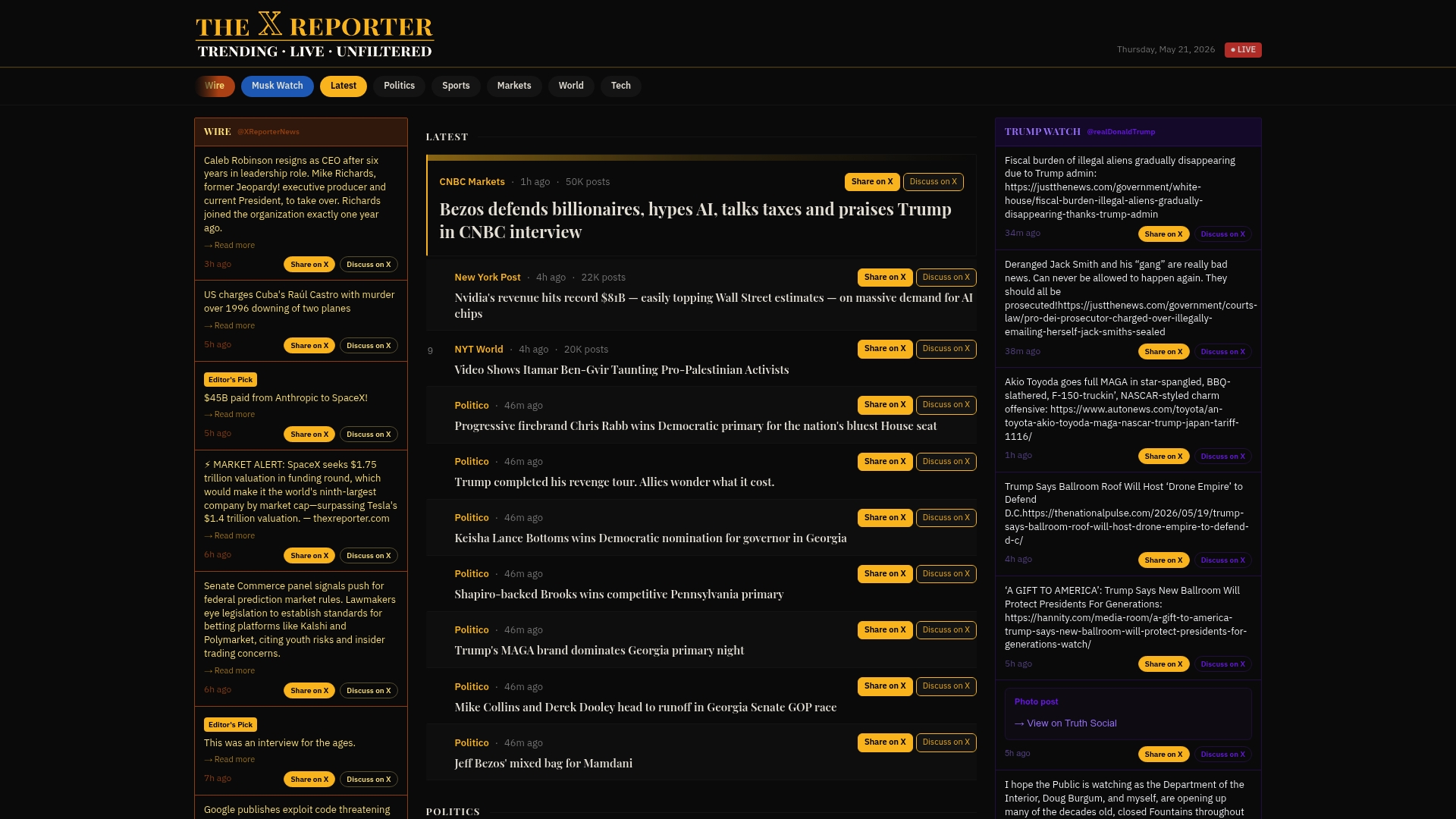
Whether you are tracking AI policy shifts, recent tech breakthroughs in semiconductor manufacturing, or cybersecurity incidents, Thexreporter distills complex stories into concise formats that highlight what matters. It complements automated workflows by serving as a credibility-checked editorial layer on top of raw feed data. For professionals who want live unfiltered tech news without building infrastructure from scratch, Thexreporter delivers that directly. Explore the platform to see how it fits your current technology trends monitoring workflow.
FAQ
What is the best way to follow technology news developments?
The most effective method combines RSS readers like Inoreader or NetNewsWire with a multi-source pipeline that ingests vendor feeds, security advisories, and journalism, then deduplicates and scores items before alerting.
How do I avoid alert fatigue when tracking tech news?
Apply tiered alerting: send only high-priority items (zero-day vulnerabilities, major launches) as push notifications, and batch routine updates into a daily or weekly digest to reduce notification volume.
Which RSS feed is best for technology news updates?
BBC Technology's feed at feeds.bbci.co.uk/news/technology/rss.xml combines text, audio, and video in a single URL updated five to seven times weekly, making it one of the most complete single-source feeds available.
How do I handle duplicate entries in RSS feeds?
Hash article content at ingestion and compare against a seen-items store. BBC RSS feeds in particular can generate duplicate entries when the guid field changes without any content update.
How often should I review technology news to stay current?
A 15-minute daily digest review combined with a weekly trend-clustering session covers most professional needs, with real-time alerts reserved for critical security or regulatory developments only.