

Breaking news coverage is defined as real-time journalistic reporting of urgent, unfolding events using live updates, verified source attribution, and quantitative impact data. CBS News, BBC, Reuters, and TechRadar each demonstrate this practice across conflict, politics, technology, and financial markets. The standard for effective coverage is not speed alone. It is speed combined with verification, explicit attribution, and data that gives readers immediate context. Thexreporter tracks these standards daily across sectors to help journalists and news enthusiasts recognize what separates credible reporting from noise.
1. Examples of breaking news coverage in conflict and political crises
Conflict reporting produces some of the most instructive examples of breaking news coverage because the stakes of inaccuracy are highest. CBS News live updates on the Iranian attack on Kuwait airport reported 13 missiles and 17 drones, at least 63 wounded, and flight disruption data. Each update carried a timestamp, a named source, and a quantified impact figure. That combination is the structural baseline for conflict coverage done correctly.
BBC's approach to the same regional escalation added a second layer: contextual framing that linked new developments to the April truce and warned readers of conditional retaliation scenarios. This technique prevents readers from treating each update as an isolated event. It builds a causal chain that makes the story comprehensible across multiple news cycles.

Human-impact reporting requires a different discipline. BBC's coverage of a contested West Bank incident named the victim, Alaa Subeih, 28, and attributed competing accounts separately to his family and the Israeli military. That separation of sources is not a stylistic choice. It is a verification standard that prevents unconfirmed allegations from being presented as established fact.
Key structural elements in conflict breaking news:
- Timestamps on every update to establish sequence
- Named institutional sources for each claim
- Casualty and impact figures drawn from official counts
- Explicit separation of confirmed events from disputed allegations
- Contextual links to prior developments in the same conflict
Pro Tip: When covering conflict, create a running source log alongside your live update file. Label each claim with its source tier before publishing. This prevents Tier 2 social media claims from appearing alongside Tier 1 official statements without distinction.
2. Technology outage incidents as breaking news
Technology outage coverage follows a more structured format than conflict reporting, and that structure is itself a best practice. TechRadar's live report on the Anthropic Claude outage in June 2026 anchored the story with a precise start time of 2:10am ET, tracked Downdetector report volumes as a proxy for user impact, and updated readers as the fix was implemented. Tech audiences expect operator-confirmed incident details plus real user impact data to grasp scope immediately. Downdetector metrics serve that function when official status pages lag behind actual user experience.
The format elements that define effective technology outage coverage include:
- Incident start time with timezone specified
- Geographic and user scope drawn from monitoring tools like Downdetector
- Official status page updates cited directly
- Timeline of fix implementation with confirmation messaging
- Distinction between affected and unaffected services
This format works because it mirrors how engineers and IT professionals diagnose incidents internally. Readers in technical roles can map the coverage directly onto their own workflows. For general audiences, the timeline structure converts a complex infrastructure failure into a readable sequence of cause, impact, and resolution.
3. Breaking news coverage in global financial markets
Markets coverage is the most quantitatively dense form of breaking news, and that density is its defining strength. Reuters and LSE reporting on the Middle East conflict escalation recorded the Dow falling 0.84%, the S&P 500 down 0.48%, the Nasdaq declining 0.72%, and Brent crude rising 1.89% in direct response to the escalation news. Those numbers mean nothing without the catalyst. Anchoring each index move to the specific breaking event is what converts raw data into news.
| Market indicator | Move | Catalyst |
|---|---|---|
| Dow Jones | Down 0.84% | Iran conflict escalation |
| S&P 500 | Down 0.48% | Iran conflict escalation |
| Nasdaq | Down 0.72% | Iran conflict escalation |
| Brent crude | Up 1.89% | Iran conflict escalation |
Market news reporting anchors numeric moves to catalyst events with directional context to help readers interpret magnitude and implications quickly. The oil price increase alongside equity declines tells a specific story about investor risk perception. Without that pairing, readers see numbers. With it, they see a market narrative.
Pro Tip: In markets breaking news, always include the directional relationship between asset classes. An equity decline paired with a commodity price rise signals risk-off behavior. Stating that relationship explicitly saves readers the interpretive step and increases the utility of your coverage.
4. Comparing formats and workflows in breaking news coverage
Live-updating pages and narrative rewrites serve different editorial purposes, and choosing the wrong format for a story type reduces both speed and accuracy. Live-updating pages function as event timelines with checkpoints, accumulating independently verified facts rather than rewriting background context with each new development. CBS News used this structure across the Iran-Kuwait coverage to maintain a running sequence of ceasefire pauses, airspace closures, casualty counts, and diplomatic exchanges.
| Format | Best use case | Core advantage |
|---|---|---|
| Live-updating timeline | Conflict, outages, elections | Accumulates facts without rewriting context |
| Narrative rewrite | Post-event analysis, features | Synthesizes developments into coherent story |
| News alert | Single confirmed fact | Maximum speed, minimum context |
| Explainer update | Complex ongoing stories | Contextualizes new facts against background |
Source tiering is the editorial workflow that makes live formats credible. Editors prioritize Tier 1 official statements before corroboration and treat social media posts as provisional, lower-tier information. This prevents rumors from entering the live update stream before independent confirmation. Journalism playbooks for sports, entertainment, and conflict coverage all apply this same hierarchy, though the specific Tier 1 sources differ by beat.
The verification workflow for breaking news also governs how quickly a story can be updated. Outlets that pre-establish source relationships with official bodies, government press offices, and corporate communications teams can confirm facts faster than those relying on reactive outreach. Speed in breaking news is partly a function of preparation, not just execution.
Key takeaways
Effective breaking news coverage requires live updates, verified source attribution, and quantified impact data working together across every sector from conflict to financial markets.
| Point | Details |
|---|---|
| Conflict coverage structure | Use timestamps, named sources, and casualty figures on every update to maintain credibility. |
| Technology outage format | Pair official status updates with user-impact metrics like Downdetector data for full scope. |
| Markets reporting standard | Anchor every index move to its specific breaking event catalyst for reader clarity. |
| Source tiering discipline | Treat Tier 1 official statements as primary; label social media claims as provisional. |
| Live vs. narrative format | Use live timelines for unfolding events and narrative rewrites for post-event synthesis. |
Why speed without verification is the real risk in breaking news
The examples in this article share one structural feature that most readers overlook: they all slow down at the verification step, even when the story is moving fast. That is a deliberate editorial choice, not a limitation.
The instinct in breaking news is to publish the most dramatic claim first and verify later. The outlets that consistently produce credible coverage do the opposite. They publish the most confirmed claim first and flag everything else as developing. BBC's explicit separation of family accounts from Israeli military accounts in the West Bank coverage is not just fair journalism. It is a signal to readers that the outlet has not collapsed competing claims into a single narrative for convenience.
The tiered-source model described in journalism playbooks is not theoretical. It is the operational difference between outlets that correct retractions and those that do not. For journalists building live coverage workflows, the daily briefing checklist approach, where source tiers are pre-assigned before a story breaks, reduces the pressure to make verification decisions under deadline stress.
For news enthusiasts reading live coverage, the practical takeaway is this: count the named sources in any live update. If a claim has no named institution behind it, treat it as unconfirmed regardless of how many outlets are repeating it.
— Trevor
Stay ahead with Thexreporter's live breaking news coverage
Thexreporter applies the same standards described in this article across every sector it covers. Real-time updates on politics, technology, and global markets are verified against primary sources before publication, and each story includes the quantitative context readers need to assess significance immediately.
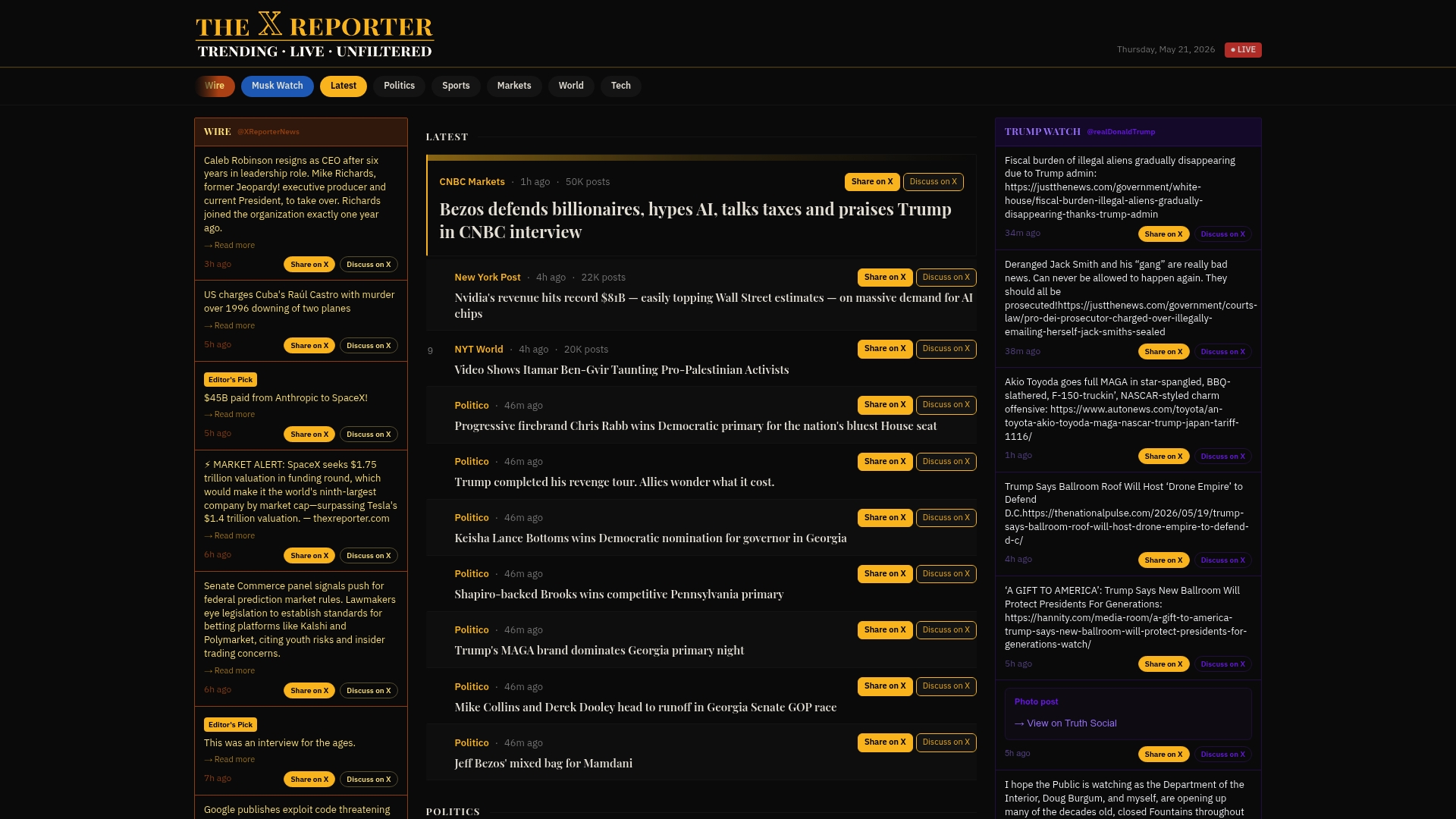
Whether you are tracking a market reaction to a geopolitical event or following a technology outage as it develops, Thexreporter's live platform delivers verified, unfiltered breaking news without the noise. The platform's editorial model prioritizes confirmed facts over speed-driven speculation, giving you coverage you can act on. For journalists and news enthusiasts who want to understand how breaking news spreads digitally and how to read it critically, Thexreporter is the reference point.
FAQ
What defines effective breaking news coverage?
Effective breaking news coverage combines real-time updates, named source attribution, and quantified impact data. CBS News and BBC demonstrate this by pairing timestamps with official casualty figures and explicitly labeled competing accounts.
How do journalists verify facts during live news reporting?
Journalists use a tiered-source model that prioritizes official statements over social media posts. Tier 1 sources are confirmed before publication; lower-tier claims are labeled provisional until independently corroborated.
What format works best for breaking news report examples?
Live-updating timelines work best for unfolding events like conflicts and outages because they accumulate verified facts without rewriting background context. Narrative rewrites are better suited for post-event analysis once the full picture is confirmed.
How is technology outage coverage different from conflict coverage?
Technology outage coverage relies on official status pages and user-impact tools like Downdetector to establish scope and timeline. Conflict coverage requires competing source attribution and human-impact details that outage reporting does not.
Why do markets breaking news reports include multiple index figures?
Reporting multiple index moves alongside commodity price changes reveals investor behavior patterns. A simultaneous equity decline and oil price rise, as seen in Iran conflict coverage, signals risk-off sentiment that a single figure cannot convey.