

News commentators are defined as media professionals who interpret, analyze, and editorialize on current events, going well beyond the factual reporting that traditional journalists provide. Their core function is to give audiences a framework for understanding what news means, not just what happened. A 2026 study published in the Journal of Science Communication found that commentator assertiveness biases beliefs even when audiences recognize the opinion as subjective. That finding reframes the importance of news commentators from a soft cultural question into a measurable public influence problem. Platforms like CNN, Fox News, and MSNBC have built entire prime-time lineups around this influence, and the consequences for political discourse are significant.
How do news commentators influence public opinion and political discourse?
The role of news commentators in shaping public belief operates through several documented mechanisms. The most studied is the use of paraverbal cues: tone, pacing, and assertiveness that signal confidence and authority to viewers. A 1,984-participant study showed that trust varies with commentator opinion, meaning audiences adjust their beliefs based on how certain a commentator sounds, not just what evidence they present. This is a significant finding because it means the delivery of commentary carries independent persuasive weight.
Modern commentary also relies heavily on performative broadcasting. Commentators combine sourcing credibility with performance, using repetition, escalation, and dramatization to sustain viewer engagement across long broadcast windows. This theatrical dimension is not incidental. It is structurally required by the 24-hour news format, which demands constant content and emotional variation to hold audiences.

The political consequences are measurable. Experts note that 24/7 news demand produced a "journalistic Roman Circus," where conflict-driven commentary attracts viewers more reliably than measured analysis. This dynamic accelerates political polarization by rewarding extreme positions and penalizing nuance. Audiences who consume commentary-heavy news consistently report stronger partisan identities than those who rely on straight news reporting.
Key mechanisms through which television pundits and political analysts shape public opinion include:
- Framing effects: Commentators select which facts to emphasize, directly influencing which issues audiences consider most important.
- Credibility transfer: When a recognized expert appears as a commentator, their authority transfers to the opinions they express, not just the facts they cite.
- Repetition and ritualized argument: Repeated exposure to a commentator's position normalizes that position, even for skeptical viewers.
- Emotional priming: Tone and affect in delivery shape how audiences emotionally respond to political figures and policies.
Pro Tip: When watching commentary-heavy news programs, identify whether the host is presenting verifiable facts or offering interpretation. The distinction changes how you should weigh what you hear.
What distinguishes the functions of news commentators from those of news analysts and reporters?
The three roles, news reporters, news analysts, and news commentators, are frequently conflated but serve distinct functions within a media organization.
| Role | Primary Function | Output Type |
|---|---|---|
| News reporter | Gathers and presents verified facts | Objective news story |
| News analyst | Researches, interprets, and contextualizes data | Evidence-based analysis |
| News commentator | Editorializes and persuades | Opinion and commentary |
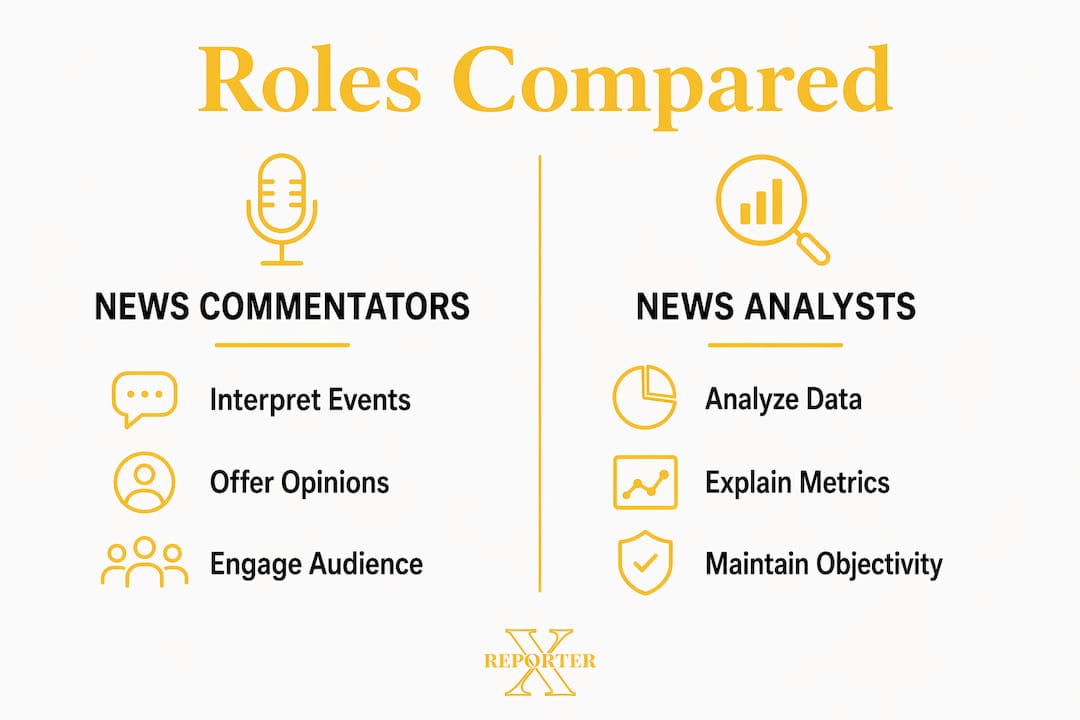
News analysts, in particular, are often misidentified as commentators. Analysts provide data-driven media coverage metrics and support evidence-based communications strategies, functioning more like researchers than broadcasters. Their work measures message reach, sentiment, and communication effectiveness, which is a fundamentally different task from appearing on television to offer opinions. Understanding news analyst responsibilities helps audiences evaluate what they are actually consuming.
News reporters operate under strict accuracy standards. Commentators, by contrast, are permitted to advocate, speculate, and editorialize. This legal and editorial distinction matters because commentary and factual reporting carry different accountability standards under most media codes. A reporter who publishes an inaccurate fact faces correction obligations. A commentator who expresses a wrong opinion faces no equivalent formal requirement.
The duties of political analysts sit between these two poles. Political analysts interpret election data, polling results, and legislative developments using quantitative methods. They present conclusions grounded in evidence, though those conclusions may carry implicit political implications. The clearest way to distinguish the three roles is to ask: is this person presenting data, explaining data, or arguing from data?
Pro Tip: Check whether a segment is labeled "News," "Analysis," or "Opinion" before forming judgments. Most major outlets use on-screen labels, though they are not always prominently displayed.
What are the ethical responsibilities and challenges facing news commentators today?
The ethical obligations of news commentators center on one foundational requirement: audiences must be able to distinguish opinion from fact. The Press Council of South Africa explicitly requires that commentary be clearly labeled and separated from objective reporting using stylistic devices and attribution. This standard reflects a broader international consensus that unlabeled opinion misleads audiences and erodes institutional trust.
The practical challenges are considerable. The infotainment demands of modern broadcasting create structural pressure to blur these lines. Commentators who speak with high assertiveness generate more viewer engagement, but assertiveness can bias audience beliefs regardless of the underlying evidence. This creates a direct conflict between what drives ratings and what serves the public interest.
Specific ethical responsibilities and challenges include:
- Transparent labeling: Commentary must be identified as such, not presented in formats that mimic straight news reporting.
- Avoiding audience manipulation: Commentators who use emotional escalation to drive political engagement bear responsibility for the polarization effects that follow.
- Accuracy in interpretation: Opinion does not exempt commentators from the obligation to represent facts accurately before editorializing on them.
- Conflict of interest disclosure: Political analysts with financial or organizational ties to the subjects they cover must disclose those relationships.
- Platform accountability: Networks that profit from high-assertiveness commentary share ethical responsibility for its societal effects.
The impact of news commentary on public trust is cumulative. Each instance of unlabeled opinion or misleading framing compounds audience skepticism toward all media, including legitimate reporting.
How has the 24-hour news cycle transformed the role of news commentators?
Ted Turner's CNN, launched in 1980, created the structural conditions that made news commentators central figures in American media. CNN's continuous news coverage elevated commentators as key figures managing rapid information flow and global news access. Before CNN, commentary occupied limited editorial space. After it, commentary became the primary mechanism for filling broadcast hours when breaking news was unavailable.
The "time is currency" environment of 24-hour news forces rapid content production, often blurring the line between factual reporting and opinionated speculation. Networks need content every hour, and verified reporting takes time. Commentary is faster to produce and cheaper to broadcast, which makes it structurally dominant in the modern news economy.
| Era | News Format | Commentator Role |
|---|---|---|
| Pre-CNN (before 1980) | Scheduled broadcasts | Limited editorial segments |
| CNN era (1980s to 2000s) | 24-hour continuous | Fill-in analysis and opinion |
| Social media era (2010s to present) | Real-time, fragmented | Central personality-driven figures |
The shift from objective reporting to personality-driven coverage also changed civic engagement patterns. Audiences began following specific commentators rather than news organizations, creating parasocial relationships that amplify the influence of individual voices. This fragmentation makes media literacy more difficult and the functions of news analysts harder for general audiences to distinguish from pure opinion.
Key takeaways
News commentators hold measurable influence over public beliefs and political discourse, and that influence is amplified by assertiveness, performance, and the structural demands of 24-hour broadcasting.
| Point | Details |
|---|---|
| Commentators shape beliefs through delivery | Assertiveness and tone bias audience beliefs independently of the evidence presented. |
| Commentary differs from analysis and reporting | Reporters verify facts, analysts interpret data, and commentators editorialize and persuade. |
| Ethical labeling is a formal requirement | Press Council standards require clear separation of opinion from factual news content. |
| The 24-hour cycle elevated commentators | CNN's continuous format made commentary structurally dominant over verified reporting. |
| Audience trust is cumulative and fragile | Repeated exposure to unlabeled opinion compounds public skepticism toward all media. |
Why the conventional wisdom on news commentary gets it wrong
Most media criticism focuses on bias, asking whether a commentator leans left or right. That framing misses the more consequential issue, which is assertiveness. Research published in 2026 confirms that confident delivery shapes audience beliefs regardless of political direction. A commentator who speaks with authority about a topic they understand poorly does more damage to public discourse than a clearly partisan one, because audiences are less equipped to discount confidence than they are to discount obvious ideology.
I have watched this dynamic play out repeatedly in coverage of complex policy areas, particularly public health and economic reporting. Commentators who simplify aggressively to sound decisive consistently outperform those who accurately convey uncertainty. The audience rewards certainty. The media rewards the audience. The result is a systematic bias toward overconfident commentary across the political spectrum.
The solution is not less commentary. It is better-calibrated commentary, where viral political commentary is matched with transparent sourcing and explicit acknowledgment of what is known versus inferred. Audiences who understand the difference between a commentator's opinion and a reporter's verified fact are harder to manipulate and more resilient to polarization. That media literacy gap is the real problem worth solving in 2026.
— Trevor
Stay informed with Thexreporter

Thexreporter delivers timely editorial summaries across politics, markets, and technology, with a clear separation between factual reporting and commentary. The platform is built for readers who want context without the noise of personality-driven broadcasting. Every summary on Thexreporter identifies whether content is straight news or editorial interpretation, so you always know what you are reading. For anyone tracking political developments or market movements, that distinction is not a minor detail. It is the foundation of informed decision-making. Explore the latest coverage and see how structured, balanced news coverage changes how efficiently you stay informed.
FAQ
What is the role of news commentators?
News commentators interpret and editorialize on current events, providing audiences with frameworks for understanding news beyond raw facts. Their role differs from reporters, who verify and present facts, and from analysts, who interpret data using quantitative methods.
How do news commentators influence public opinion?
Commentators influence public opinion through assertiveness, framing, and performative delivery. A 2026 study found that commentator assertiveness biases audience beliefs even when viewers recognize the opinion as subjective.
What are the duties of political analysts vs. commentators?
Political analysts interpret polling data, election results, and legislative developments using evidence-based methods. Commentators editorialize and advocate, operating under different accountability standards than analysts or reporters.
Why does the 24-hour news cycle matter for commentary?
Ted Turner's CNN created continuous news broadcasting, which structurally elevated commentators because commentary is faster and cheaper to produce than verified reporting. This shift made personality-driven opinion a dominant format in modern news.
How can audiences distinguish commentary from news reporting?
Most outlets label segments as "News," "Analysis," or "Opinion," though labels are not always prominent. The Press Council of South Africa and similar bodies require clear separation of commentary from factual reporting as an ethical standard.