

The stock market is a system where investors buy and sell ownership shares in public companies to grow wealth or generate profit through trading. Equities markets, the formal term for this system, span exchanges like the New York Stock Exchange and Nasdaq. Whether you are a first-time investor or an active trader, the 2026 environment demands a clear framework. Elevated volatility, shifting Federal Reserve policy, and accessible brokerage platforms have changed how participation works. This guide covers the tools, strategies, and analysis methods that matter most right now.
What tools and accounts do you need to start investing in the stock market?
Opening a brokerage account is the first concrete step. Platforms like Fidelity, Charles Schwab, and Robinhood allow you to deposit funds and begin buying shares within minutes. The account transfer process typically takes one to three business days.
Fractional shares allow investors to start with as little as $1, removing the traditional barrier of needing hundreds of dollars to buy a single share. That shift makes equities accessible to anyone with a bank account. Most major platforms support fractional share purchases in 2026.
Beyond the account itself, you need a basic toolkit. Exchange-traded funds (ETFs) give you instant diversification without picking individual stocks. A brokerage's built-in screener helps you filter stocks by sector, market cap, or dividend yield.
Pro Tip: Automate a fixed monthly contribution to your brokerage account. Automation removes the temptation to delay investing during uncertain periods and builds discipline over time.
Beginner-friendly brokerage platform comparison
| Platform | Fractional Shares | Account Minimum | Best For |
|---|---|---|---|
| Fidelity | Yes | $0 | Long-term investors |
| Charles Schwab | Yes | $0 | Diversified portfolios |
| Robinhood | Yes | $0 | Active beginners |
| TD Ameritrade | Yes | $0 | Education and tools |
Which stock trading strategies work best for beginners and active traders?
The most effective approach depends on your time horizon and risk tolerance. Long-term investors, swing traders, and day traders each require a different mindset and set of rules.

Long-term investors who buy broad-market ETFs like VTI or VOO outperform 90% of professional fund managers over any 15-year span. These funds charge approximately 0.03% in annual expense ratios, meaning nearly all returns stay in your account. For most investors, this is the highest-probability path to wealth accumulation.
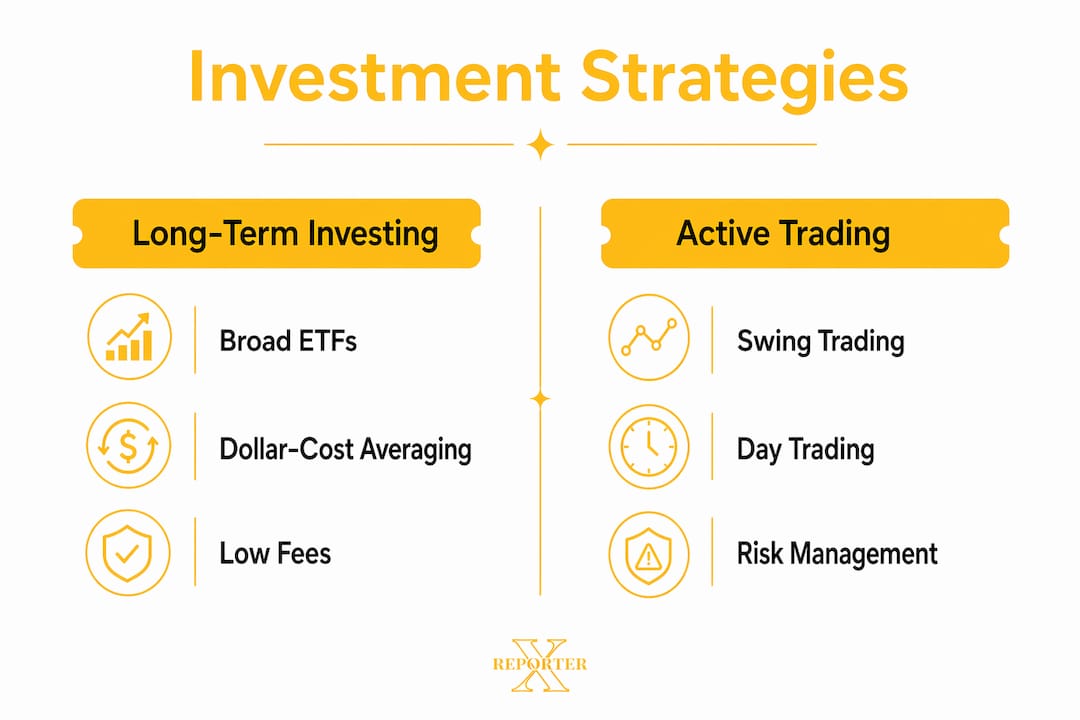
Dollar-cost averaging reduces emotional bias by investing a fixed amount at regular intervals regardless of market conditions. When prices fall, your fixed contribution buys more shares. When prices rise, it buys fewer. Over time, this smooths your average purchase price.
Swing trading targets price moves over two to ten days. Strategies like pullback buys and support/resistance bounces are common entry methods. Backtesting any strategy at least 50 times in a simulator before risking real capital is the standard recommendation from experienced traders.
The numbered list below summarizes four core strategies and when each applies:
- Buy-and-hold ETF investing. Use this when your time horizon exceeds five years and you want low-cost, diversified exposure to the broad market.
- Dollar-cost averaging. Use this in volatile or uncertain markets to reduce the risk of investing a lump sum at a market peak.
- Swing trading. Use this when you can monitor positions daily and have a tested, rule-based entry and exit plan.
- Day trading. Reserve this for experienced traders with strict risk controls. It requires significant time, capital, and psychological discipline.
Pro Tip: Write down your entry criteria, target price, and stop-loss level before placing any trade. A written plan prevents impulsive decisions when a position moves against you.
How can investors analyze current market trends and volatility?
Mid-2026 market volatility is elevated due to central bank interest rate uncertainty. On june 17, 2026, the S&P 500 fell 1.21%, the Nasdaq dropped 1.34%, and the Dow declined 0.98% following hawkish Federal Reserve signals. Those moves reflect how sensitive equities remain to rate hike expectations.
Three major indices serve as the primary benchmarks for market health. The S&P 500 tracks 500 large-cap U.S. companies and is the most widely followed gauge of overall market performance. The Nasdaq skews toward technology and growth stocks, making it more sensitive to rate changes. The Dow Jones Industrial Average tracks 30 blue-chip companies and moves more slowly than the other two.
Advanced traders use dealer-positioning data to anticipate structural support and resistance levels. Gamma Exposure (GEX) requires sufficient open interest to be meaningful. In high implied volatility stocks, vanna and charm flows can force unwanted dealer selling even when gamma is positive. That counterintuitive behavior catches many traders off guard.
Key volatility indicators and what they reveal:
- VIX (CBOE Volatility Index). Measures expected 30-day volatility in the S&P 500. Readings above 20 signal elevated fear.
- Implied volatility (IV). Shows how much the options market expects a stock to move. High IV inflates option premiums.
- Gamma Exposure (GEX). Indicates whether dealer hedging activity will amplify or dampen price swings.
- Average True Range (ATR). Measures a stock's average daily price range. Useful for setting realistic stop-loss levels.
Pro Tip: Match your position size to your risk tolerance before entering any trade. Diversification is the primary tool for managing risk during volatile periods, not prediction.
What are the most common investing mistakes and how do you fix them?
Emotional decision-making is the single most destructive force in retail investing. Trading psychology is the hardest part of execution. Rule-based strategies exist precisely to remove emotion from the equation.
Chasing popular stocks after a major price run is a related error. By the time a stock appears in mainstream headlines, most of the move has already occurred. Buying at that point means accepting elevated risk for diminished reward.
Lack of diversification concentrates risk unnecessarily. Holding five stocks in the same sector exposes you to a single macro event. Spreading capital across sectors, geographies, and asset classes reduces that exposure without sacrificing return potential.
Common beginner mistakes and their fixes:
- Mistake: Investing without a plan. Fix: Define your time horizon, risk tolerance, and exit criteria before buying.
- Mistake: Ignoring fees. Fix: Choose low-cost ETFs and zero-commission platforms to protect returns.
- Mistake: Timing the market. Fix: Use dollar-cost averaging to remove the pressure of picking the perfect entry point.
- Mistake: Skipping backtesting. Fix: Test every strategy in a simulator before committing real capital.
Pro Tip: Keep a trading journal. Record every trade with your rationale, entry price, exit price, and outcome. Reviewing it monthly reveals patterns in both your wins and your errors.
Key Takeaways
Successful stock market participation requires the right tools, a tested strategy, and disciplined risk management aligned with your individual time horizon and tolerance for loss.
| Point | Details |
|---|---|
| Start with a brokerage account | Platforms like Fidelity and Schwab offer $0 minimums and fractional share access from $1. |
| Use ETFs for long-term growth | VTI and VOO outperform most active managers over 15 years at near-zero cost. |
| Dollar-cost average in volatile markets | Fixed regular contributions smooth purchase prices and remove emotional timing pressure. |
| Analyze volatility with multiple metrics | VIX, implied volatility, and GEX together give a clearer picture than any single indicator. |
| Backtest before trading live | Test any strategy at least 50 times in a simulator before risking real capital. |
What I have learned about trading discipline the hard way
Most investors spend too much time searching for the perfect strategy and too little time executing any strategy consistently. The uncomfortable truth is that a mediocre strategy applied with discipline outperforms a brilliant strategy applied erratically.
I have watched traders abandon sound systems after two or three losing trades, only to see those same systems recover strongly in the following weeks. The problem was never the strategy. The problem was the inability to tolerate short-term drawdowns while trusting a long-term edge.
The 2026 environment reinforces this point. Rate hike fears, index swings, and headline-driven selloffs create noise that feels like signal. Experienced traders know the difference. They follow breaking news across key sectors not to react to every headline, but to contextualize what the market is pricing in.
My honest recommendation: pick one strategy, backtest it thoroughly, and trade it for at least three months before evaluating results. Patience is not passive. It is the active choice to let your edge play out.
— Trevor
Stay ahead of market moves with Thexreporter
Market conditions in 2026 change fast. A rate signal from the Federal Reserve, a surprise earnings report, or a geopolitical development can shift sentiment within hours. Staying informed is not optional for serious investors.
Thexreporter delivers real-time, unfiltered market news and analysis across equities, tech, and macroeconomic policy. The platform distills complex developments into concise summaries so you spend less time reading and more time acting. For investors tracking 2026 volatility, it provides the contextual clarity that raw news feeds lack. You can also follow technology news developments that directly affect growth stock performance. Visit Thexreporter to stay current without information overload.
FAQ
What is the stock market in simple terms?
The stock market is a system where investors buy and sell ownership shares in publicly traded companies. Major U.S. exchanges include the New York Stock Exchange and the Nasdaq.
How much money do I need to start investing in stocks?
Most platforms support fractional shares starting at $1, so there is no meaningful minimum to begin. Opening a brokerage account at Fidelity, Schwab, or Robinhood requires $0 to start.
What is dollar-cost averaging and why does it matter?
Dollar-cost averaging means investing a fixed amount at regular intervals regardless of price. It reduces the risk of buying a large position at a market peak and smooths your average cost over time.
How do I read stock market volatility indicators?
The VIX measures expected 30-day S&P 500 volatility, with readings above 20 signaling elevated fear. Implied volatility and Gamma Exposure add further context for options traders and swing traders managing multi-day positions.
What is the biggest mistake beginner investors make?
Emotional decision-making is the most common and costly error. Following a written, rule-based plan with defined entry and exit criteria is the most reliable way to avoid it.